Reducing front desk pressure through self serve player entry
Reducing front desk pressure at Mecca Bingo venues and improving player access through a flexible sign-up journey
MECCA BINGO APP & WEB • SENIOR PRODUCT DESIGNER • 2025
Introduction
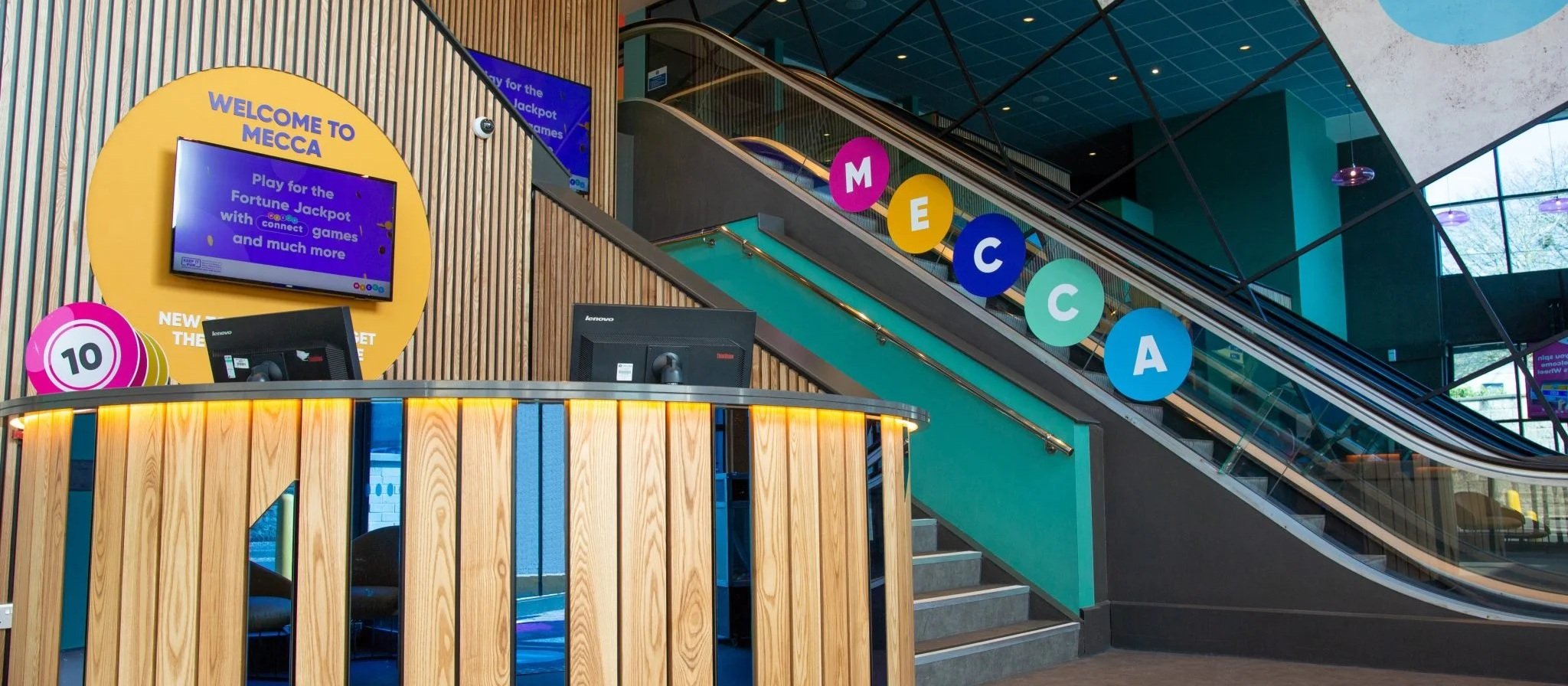
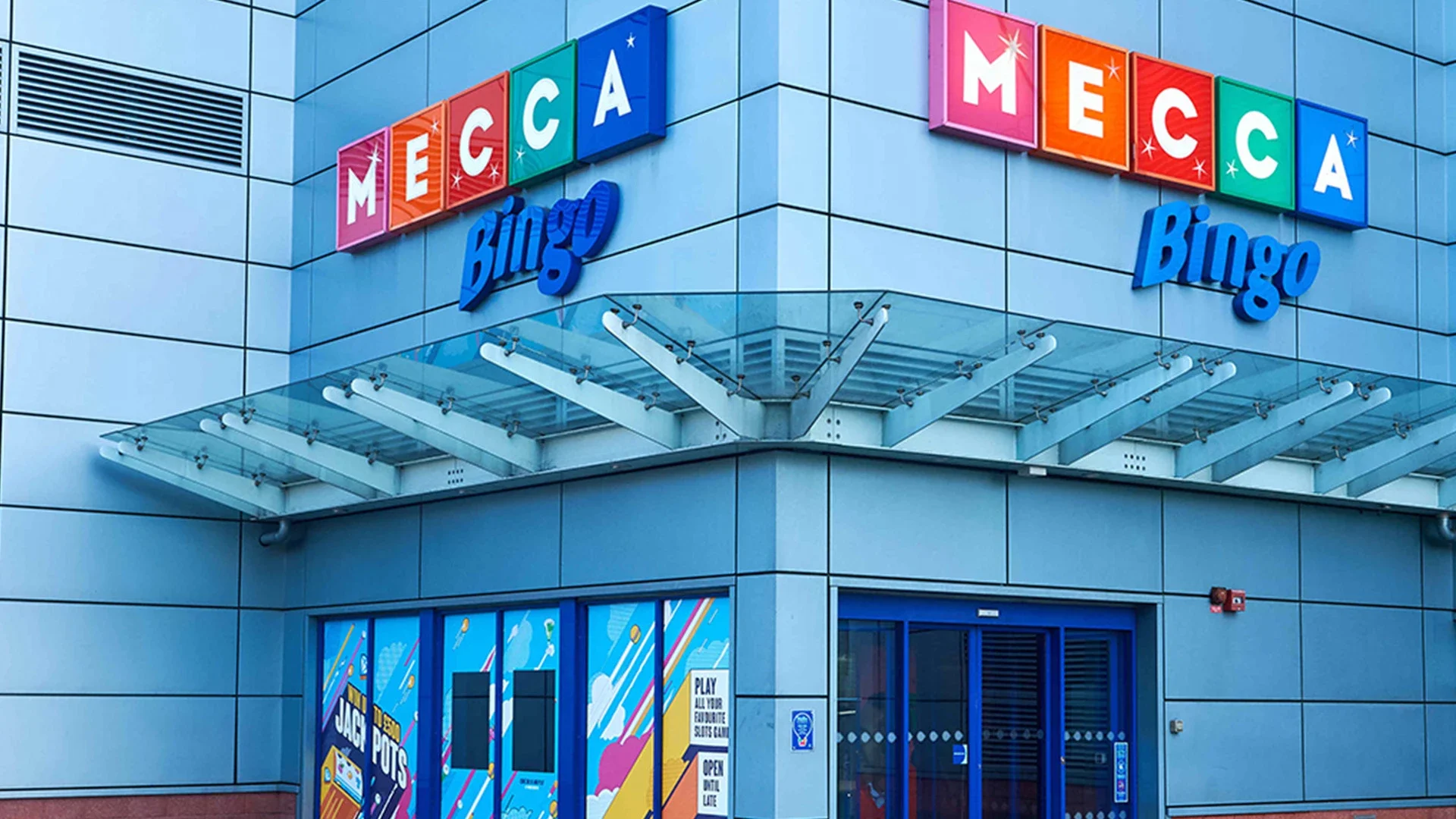
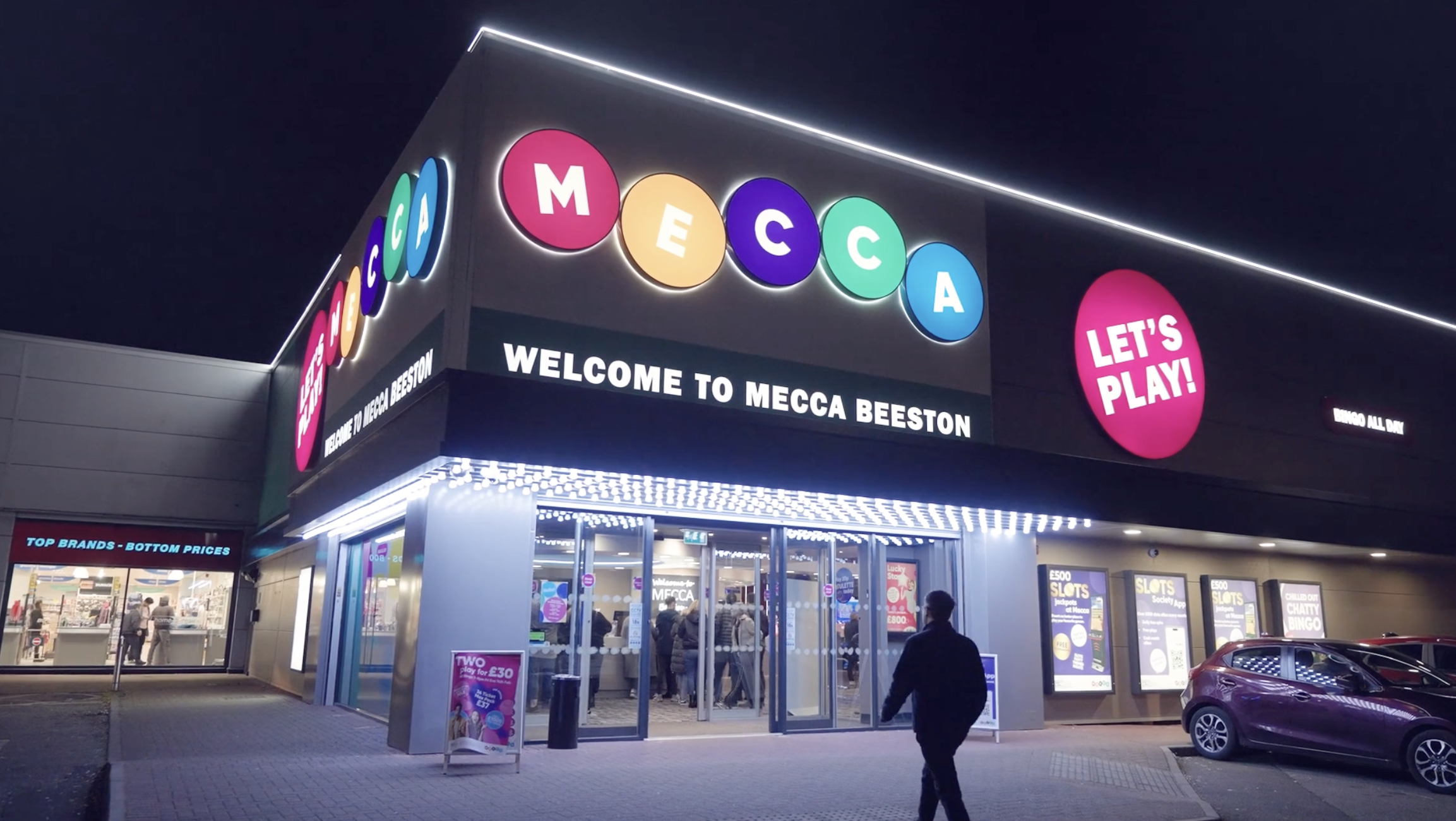
Mecca Bingo is the largest Bingo Game brand in the UK which operates across 50+ venues serving thousands of players through in-person experiences each week.
For many players the journey begins at the venue, making the front desk the primary gateway into the experience. The project began as part of a wider update to Rank’s back-office systems, creating an opportunity to modernise the legacy player management system used in Mecca Bingo venues.
The Problem
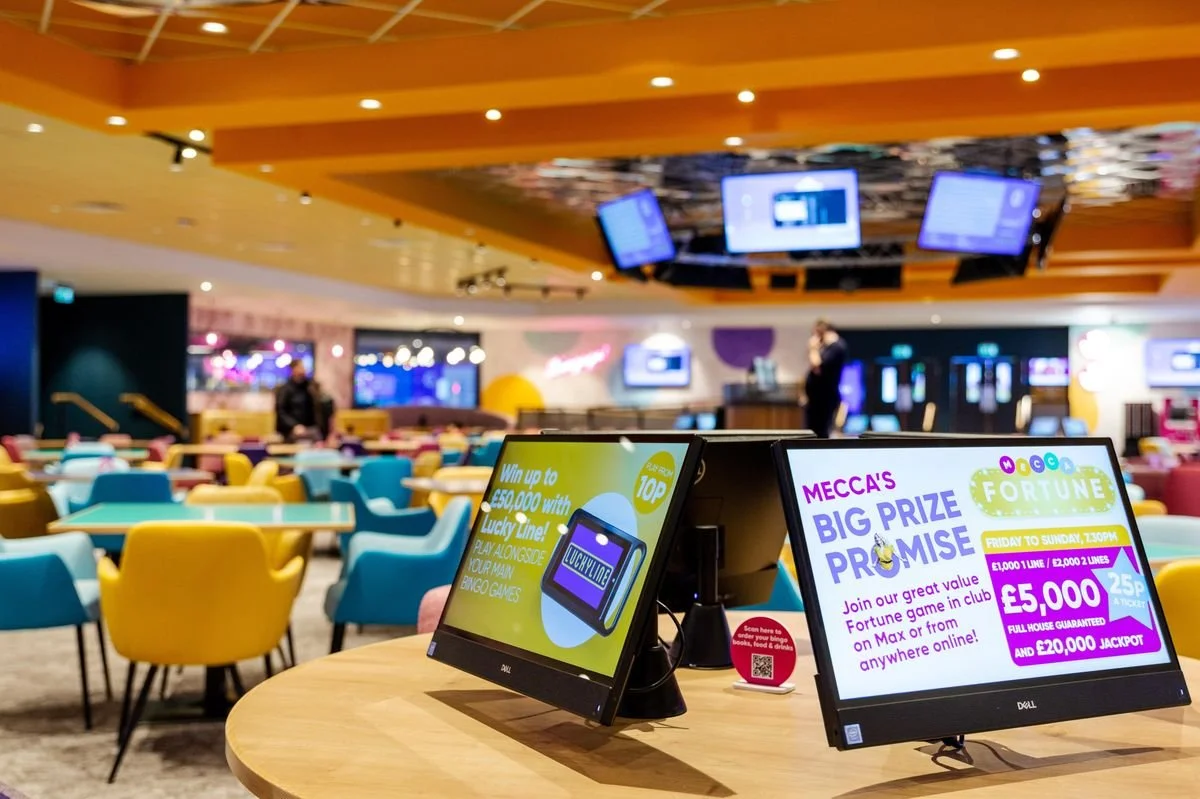
All players were required to enter through a staff assisted front desk, regardless of their needs. Staff handled everything from sign ups to account updates and game access, creating a single point of entry. This led to bottlenecks during peak times, slowing player access and placing constant pressure on staff. This impacted everyone.
Players spent less time playing, staff were stretched managing different requests and the business struggled to handle peak demand efficiently.
Problem to solve
“How might we reduce dependency on staff while improving speed of entry?”
Research
Our main focus of the research was to get a clearer idea on how player entry works in real conditions, especially during peak times.
I conducted this research by observing front desk operations in real time, mapping all entry requirements and identifying alternative methods players could access the venue.
Contextual Inquiry
For contextual inquiry, our team visited a couple of busy Mecca Bingo venues in London. We observed front desk interactions and paper based registrations. This helped to identify where unclear processes and system limitations led to errors and a poor entry experience for the users.
User feedback
“I’ve definitely created duplicate accounts without realising and I just didn’t catch it in time.”
“I wasn’t sure what they actually needed from me.”
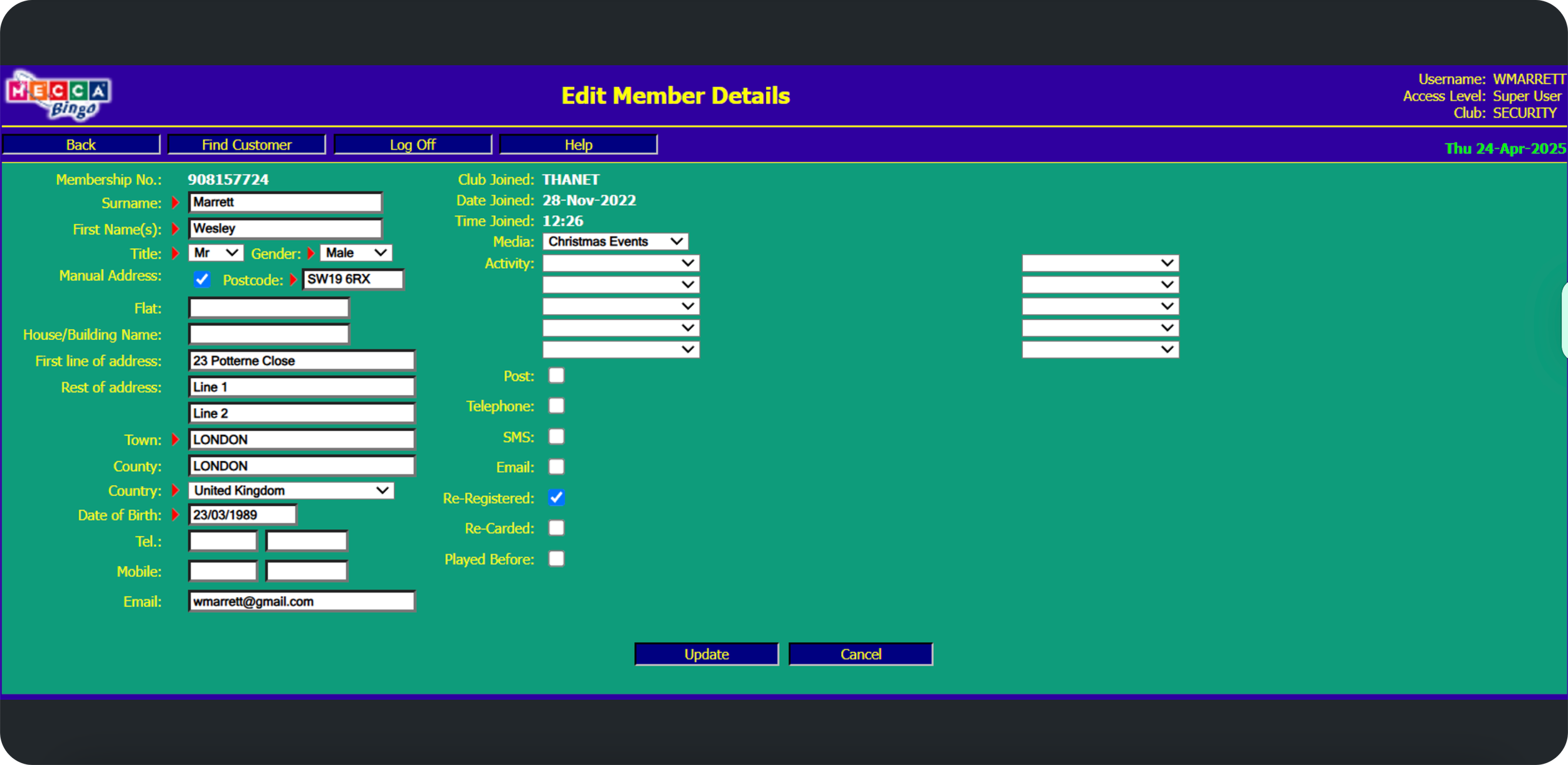
Old Mecca Bingo player management system
Player entry journey mapping
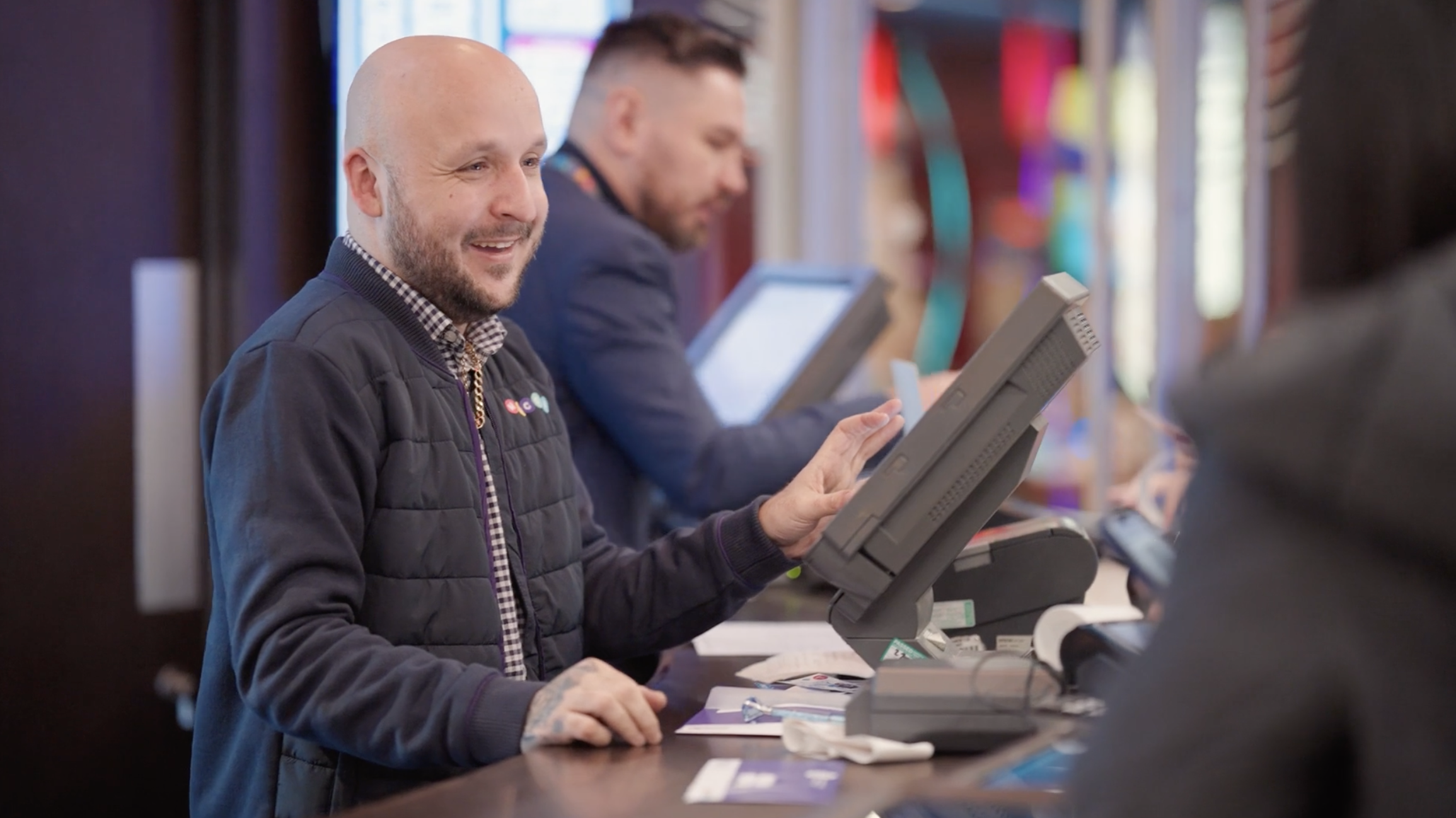
Observing the front desk during peak hours revealed long queues and staff under constant pressure as they managed system tasks and supported players simultaneously. Being on the front line revealed the pace and operational complexity of the environment.
What we saw: The front desk handled all player interactions, new registrations, returning-player identification, account management, membership access, and sensitive cases such as exclusions.
Front desk entry journey: Peak time pressure & system interaction
Outcome: The single, staff-assisted flow became a bottleneck under pressure. As queues built, staff were forced to constantly switch between tasks and screens, slowing interactions and delaying player entry into the venue.
Mapping entry requirements
To understand what is truly required for entry, I ran a workshop with front desk staff and floor managers to break down the journey into its core components. The goal was to identify what information is essential for a player to enter the venue and what can happen later without blocking access
Entry journey breakdown: Essential vs non-blocking actions
Outcome: Not all interactions need to happen at the front desk. Treating every task as the same slowed down the process of getting players into the venue. This revealed an opportunity to prioritise essential actions first and defer non-critical tasks for later.
User personas
With a clear understanding of the core journey, I explored how entry needs vary across different player scenarios. The aim was to support different levels of familiarity, confidence, and urgency at the point of arrival.
Player entry personas
Behavioral personas based on player intent at the point of entry, describing what they are trying to achieve when they arrive.
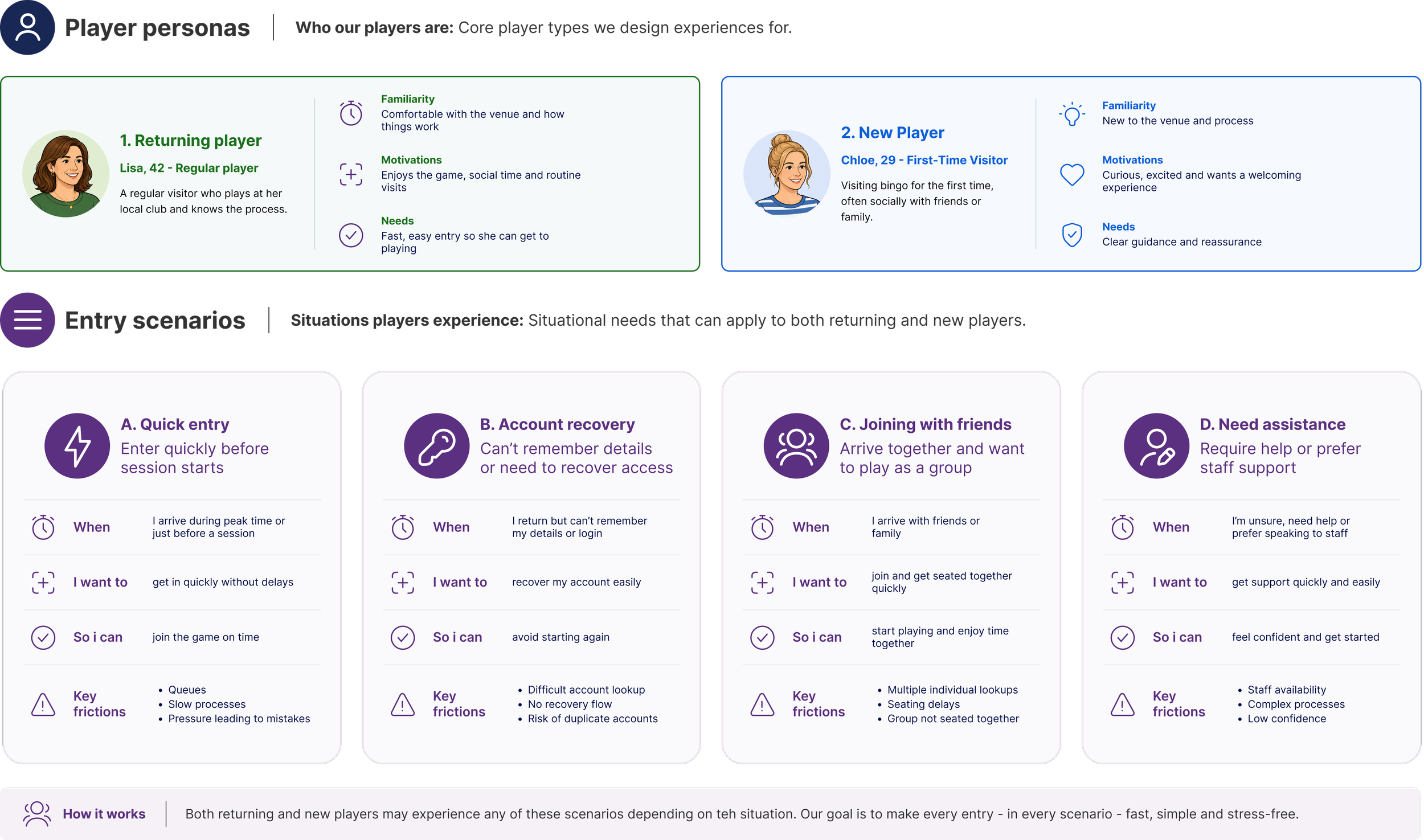
Player personas during entry
Exploring multiple entry pathways
Along with the stakeholders, I looked into how entry looks like for each of these personas. We explored the idea of introducing a self-service kiosk and mobile self-registration approach.
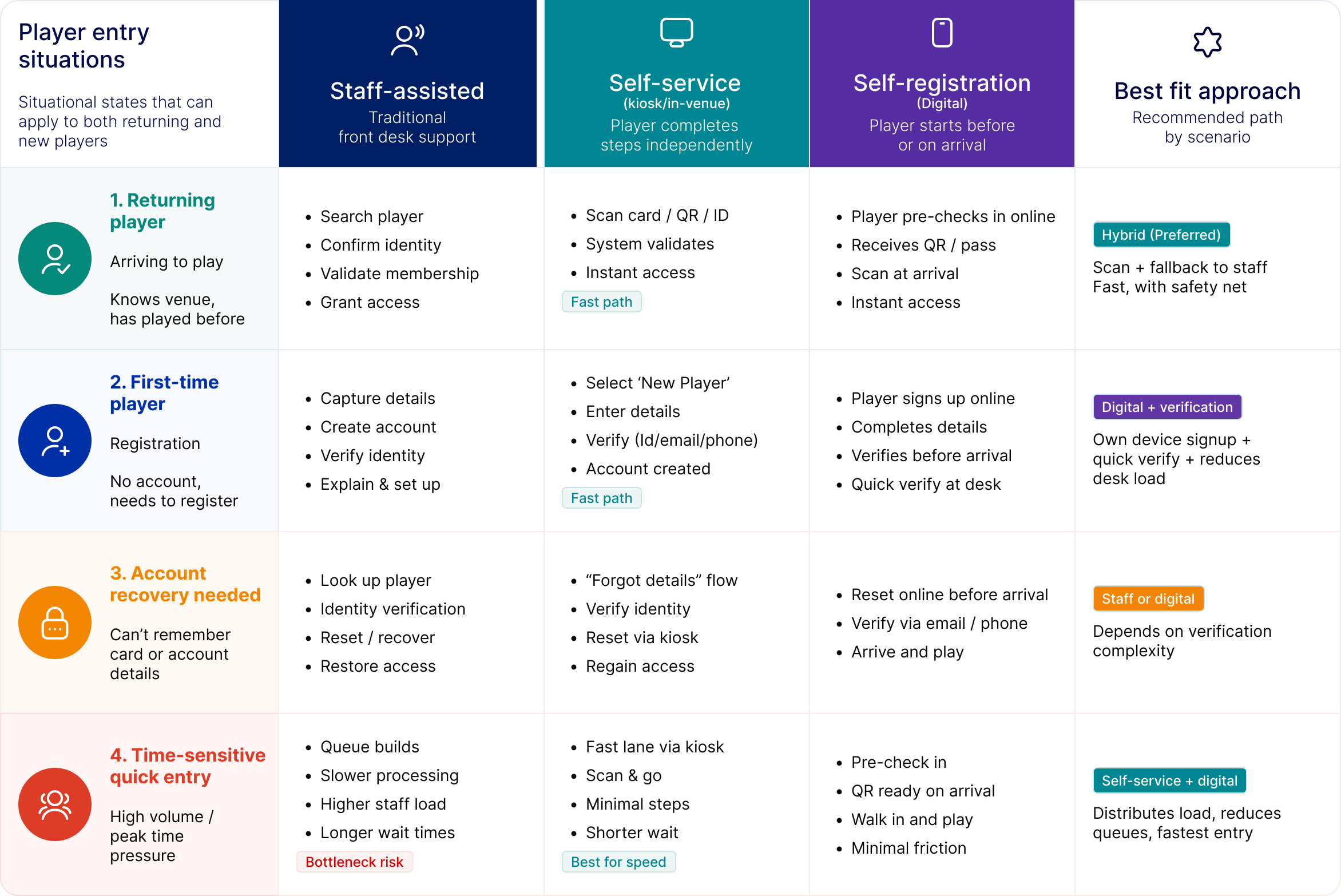
Mapping entry scenario for each player persona
Impact score card
I then scored each approach on speed, staff effort, accuracy, and scalability to understand the trade-offs during peak times.
Comparing entry approaches across key dimensions
“ Research clearly pointed to the need for a multi-path entry experience.”
Solution
The goal was to create a seamless experience that moves from a single-entry path to multiple parallel paths running simultaneously.
1. Staff-assisted experience
Player management system
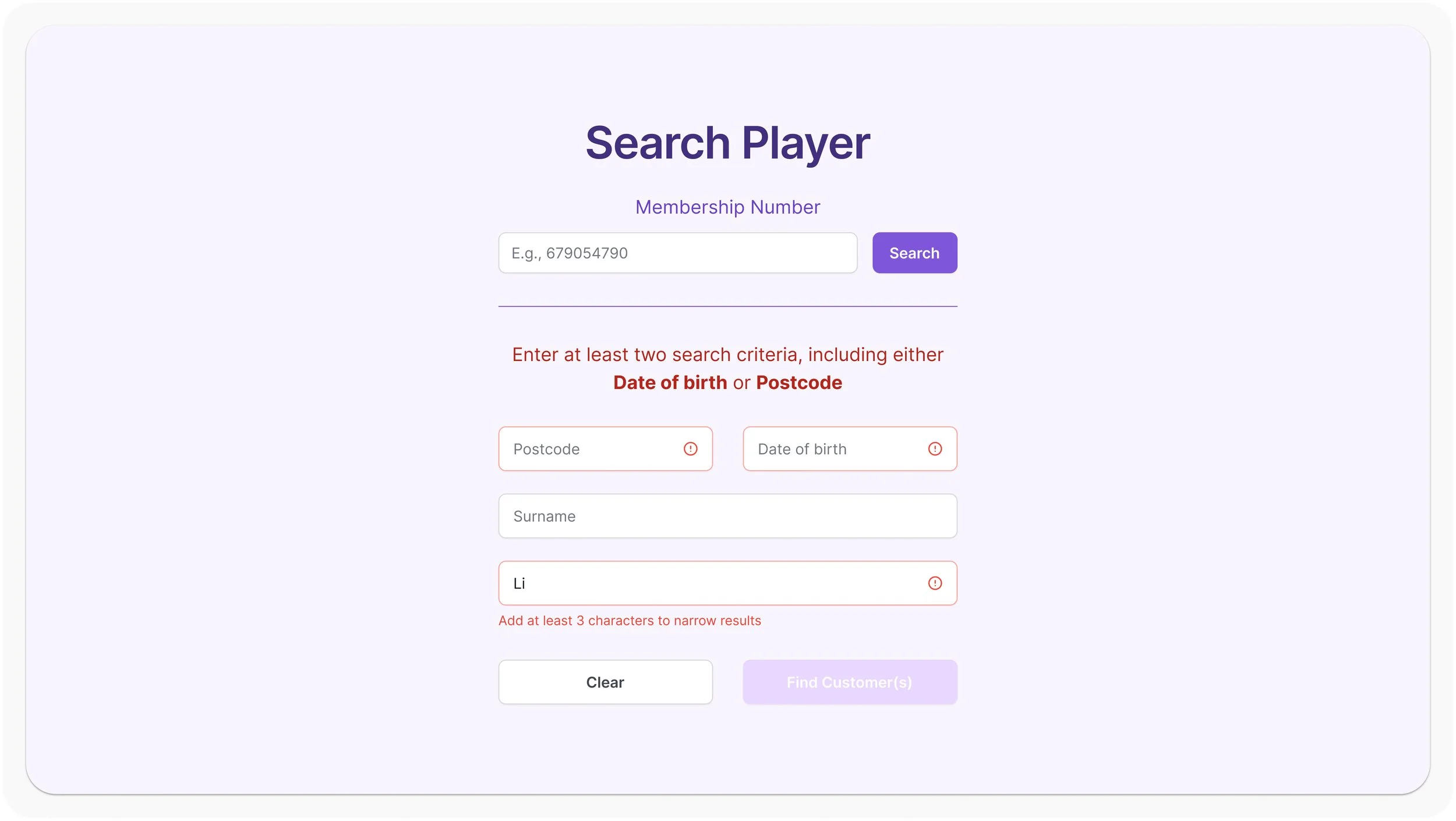
Every front desk interaction starts with the process of finding the player in the player management system. Whether entering, updating details or managing an account, search is always the first step. But search workflow was slow and inconsistent. Staff were unsure what to enter; incomplete details caused failures and repeated attempts increased queue times.
Flexible player search
Staff can search using different combinations of player information with clearer rules,
fewer repeated attempts and faster results.
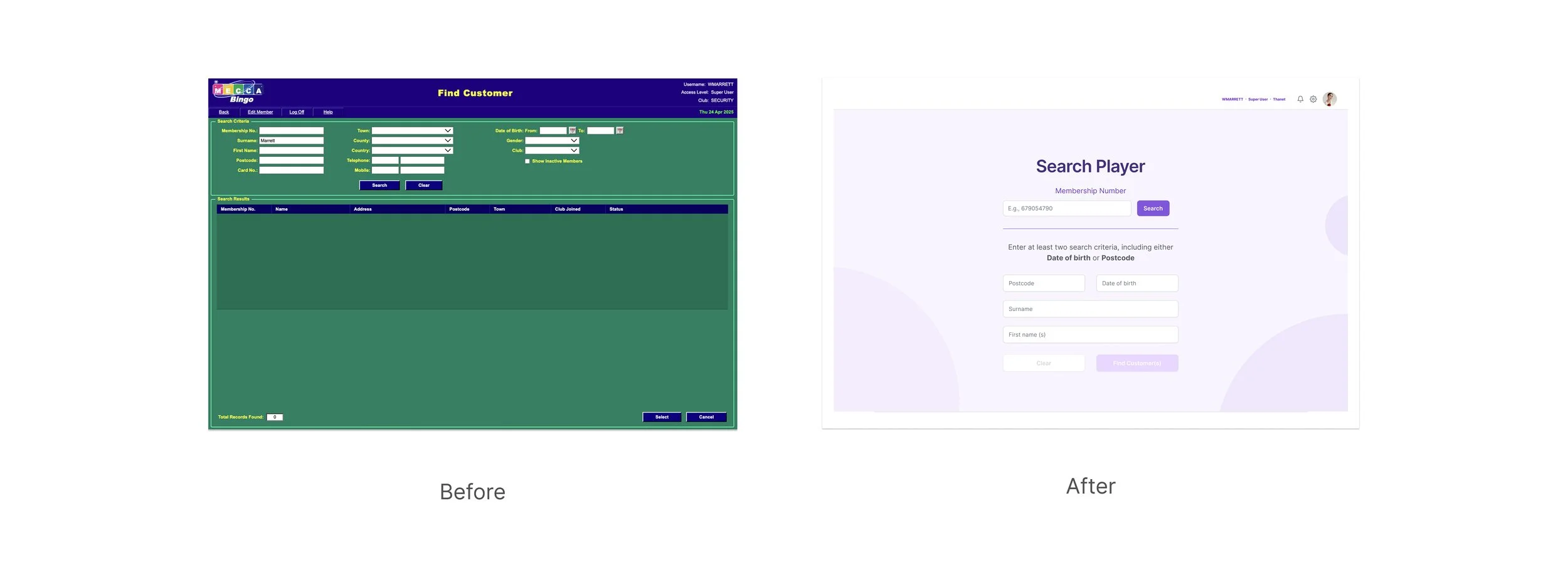
All entry journeys starts with search
Every front desk entry starts with a player search to avoid duplicate accounts. The fastest route is a membership number lookup. Staff can also search using Name + Date of Birth or Name + Postcode. This keeps results accurate and quick without needing full details.
Predictable outcomes
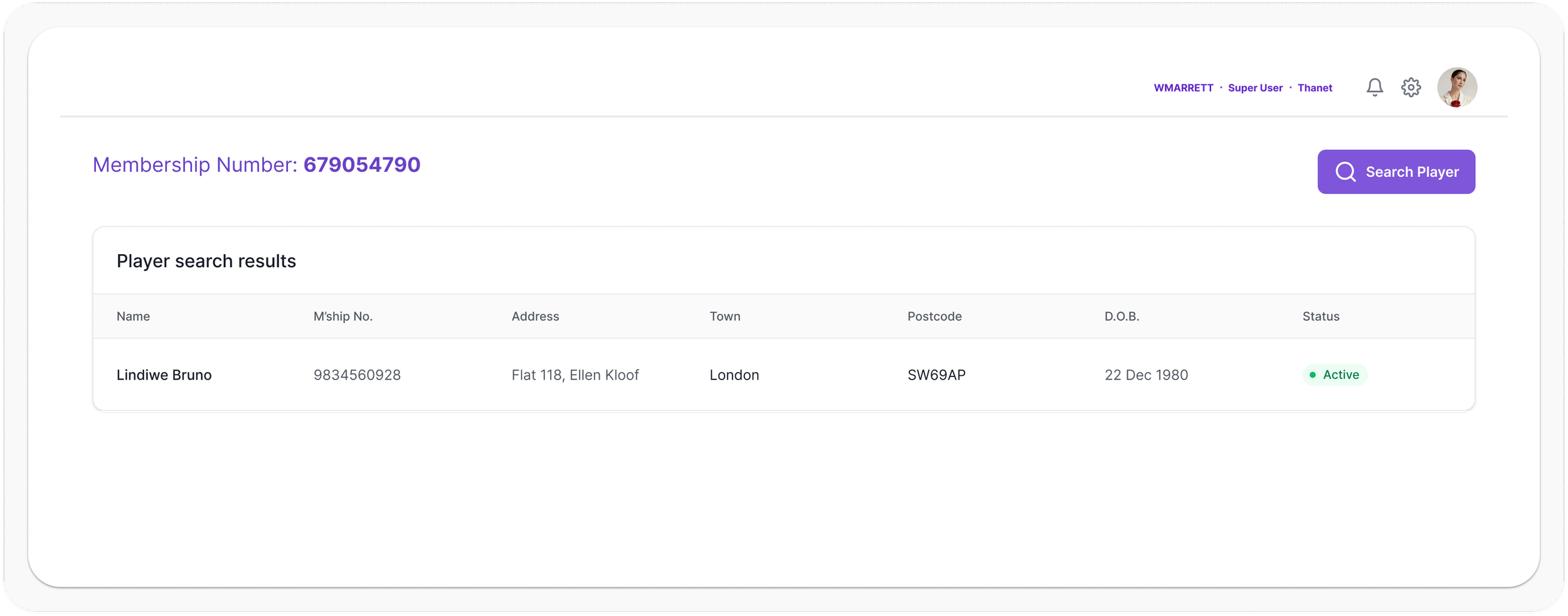
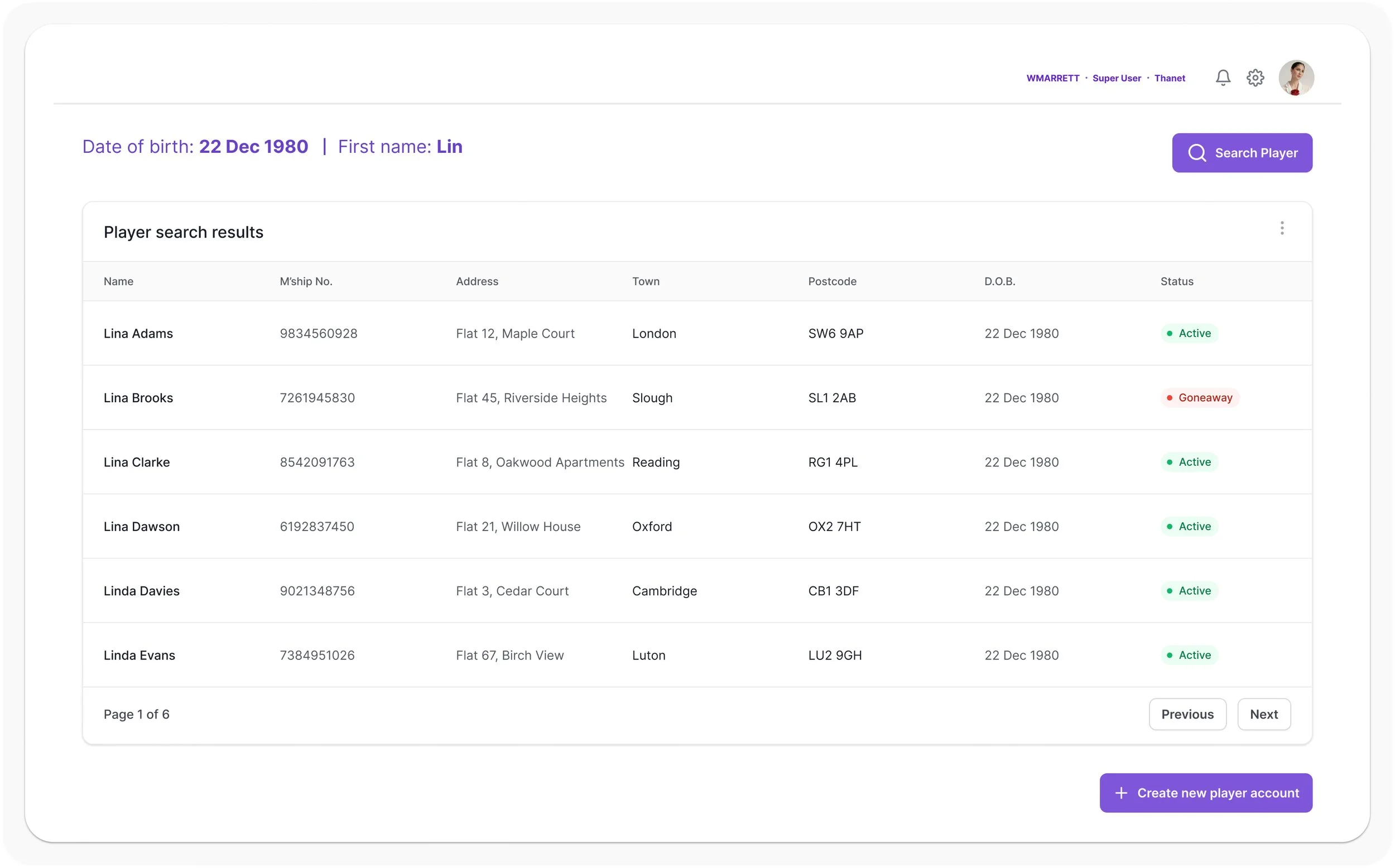
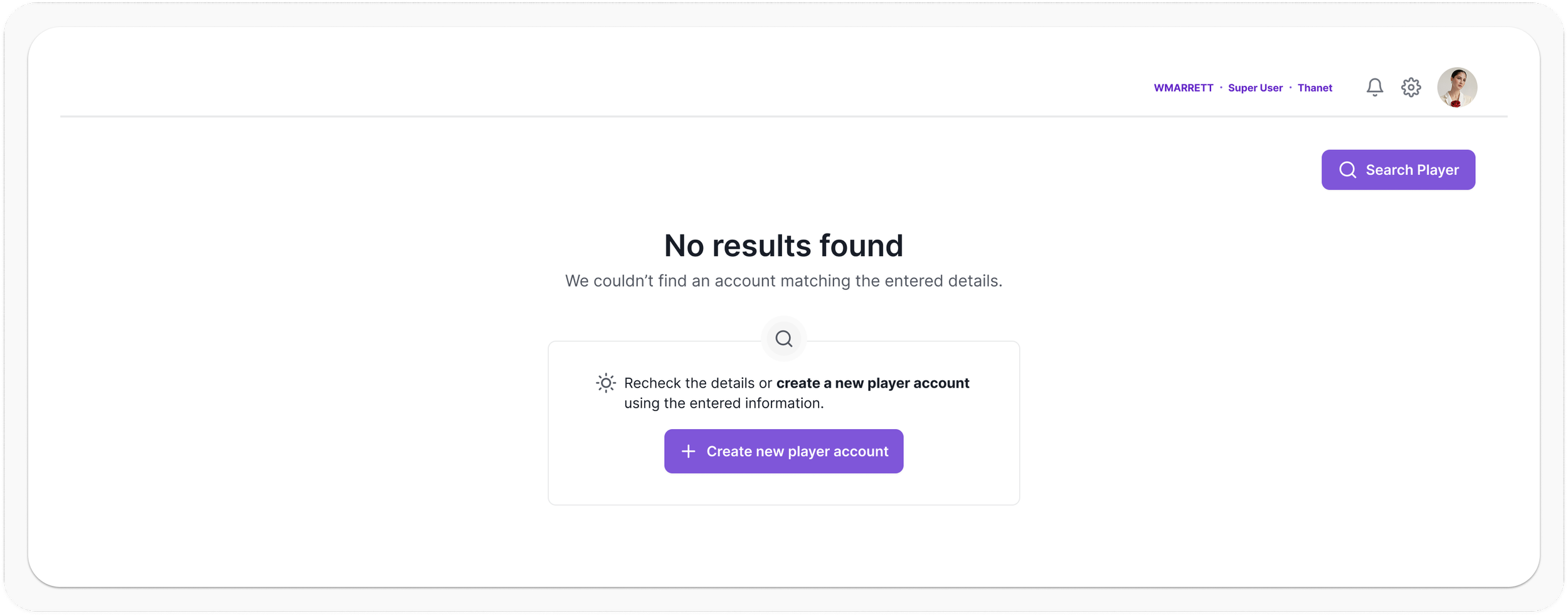
Every search leads to one of these 3 outcomes:
Exact match found
Partial search returns results for staff to confirm identity usually for an existing player.
💬 “Are any of these yours?”
Unconfirmed match
Results shown, but none belong to the player.
This will be an edge case.
💬 “None of these are mine”
No match
No results returned from search usually for a new player.
💬 “Can’t find you in our system. Can I create a new account for you?”
2. Self-service entry
Mobile
To reduce queues further, a self-service sign-up journey was introduced, allowing new players to register on their own device.
Scan QR code
When a new player arrives, staff quickly guide them to the right path based on what they have. Players with a smartphone can scan a QR code to register instantly, while those without are supported through a paper-based fallback.
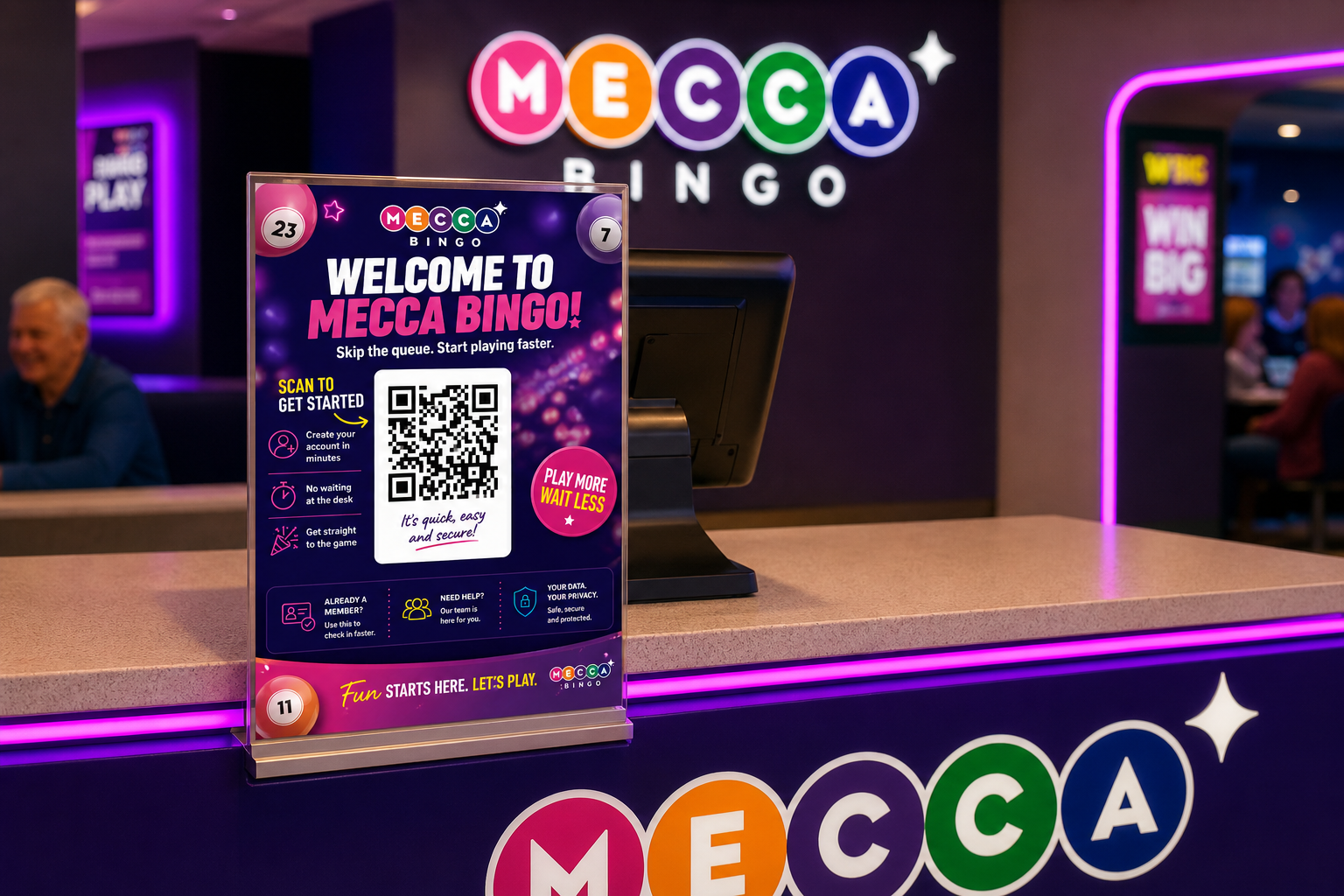
Scan the QR code poster
Sign up form final designs
After numerous discussions with stakeholders, I refined the sign-up form. Only essential details are collected to enable access, with inputs designed to meet regulatory and verification requirements. Key identifiers are captured to prevent duplicate accounts.
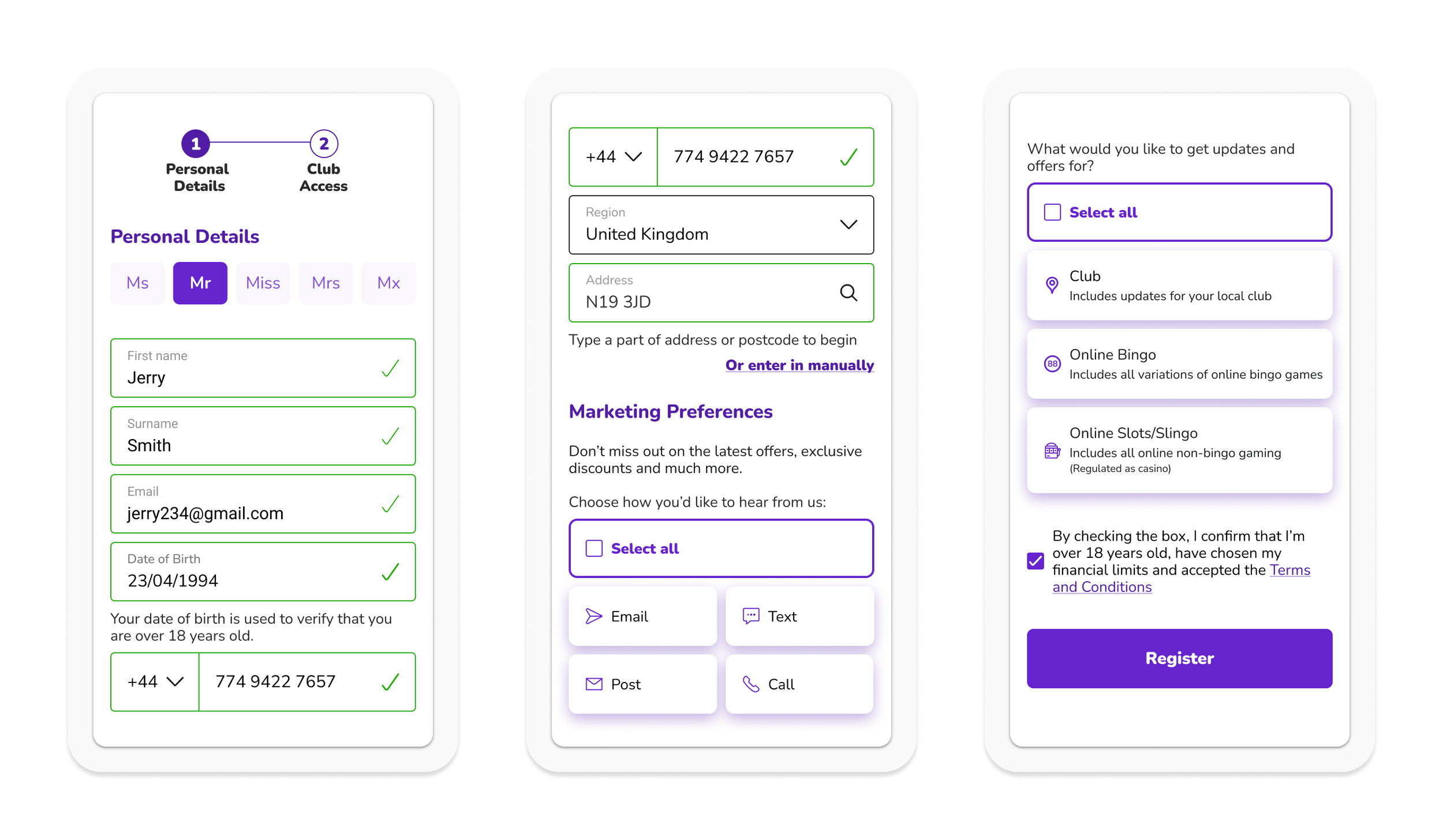
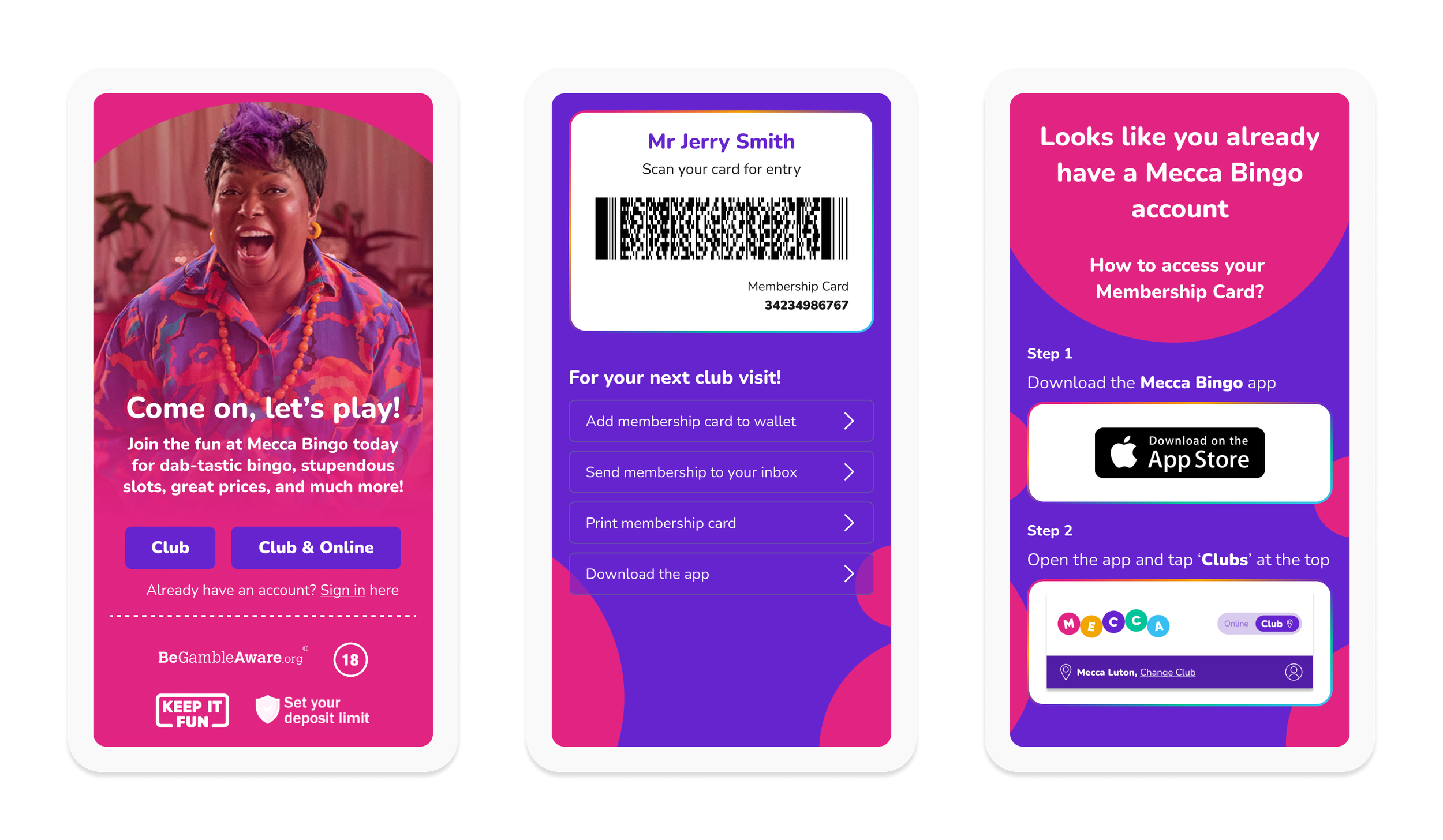
Splash screen, virtual card for instant club access & duplicate account prevention
3. Kiosk experience
While mobile sign-up worked well for many players, not everyone wanted to use a smart phone. To support all users, a kiosk experience was introduced inside the venue, giving players a way to register and manage basic account needs without relying on staff.
How it works
1. Simple starting point
Players approach the kiosk and choose what they want to do from the home screen
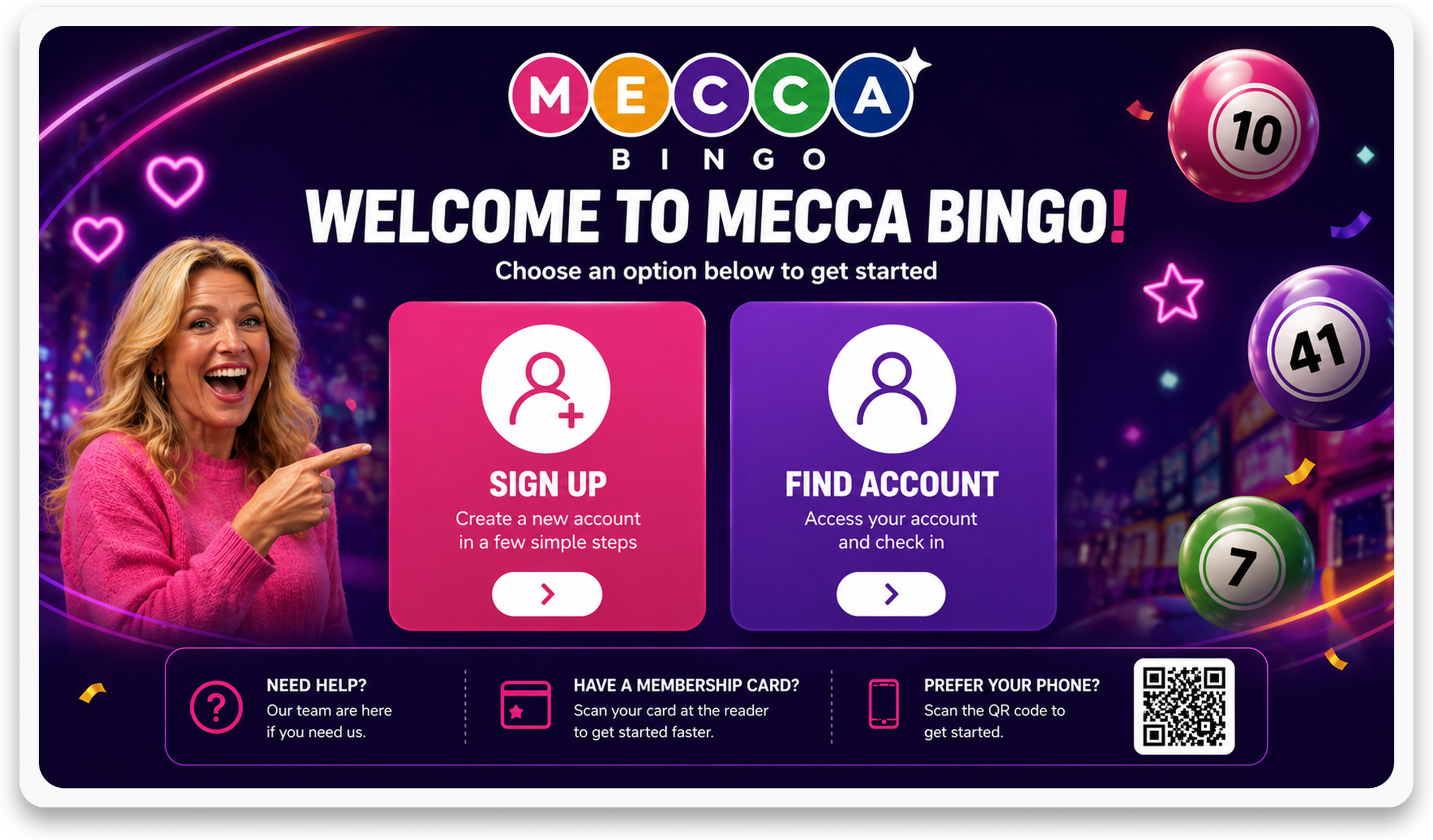
”Sign up / “Find account”
2. New player sign-up
The kiosk mirrors the mobile experience
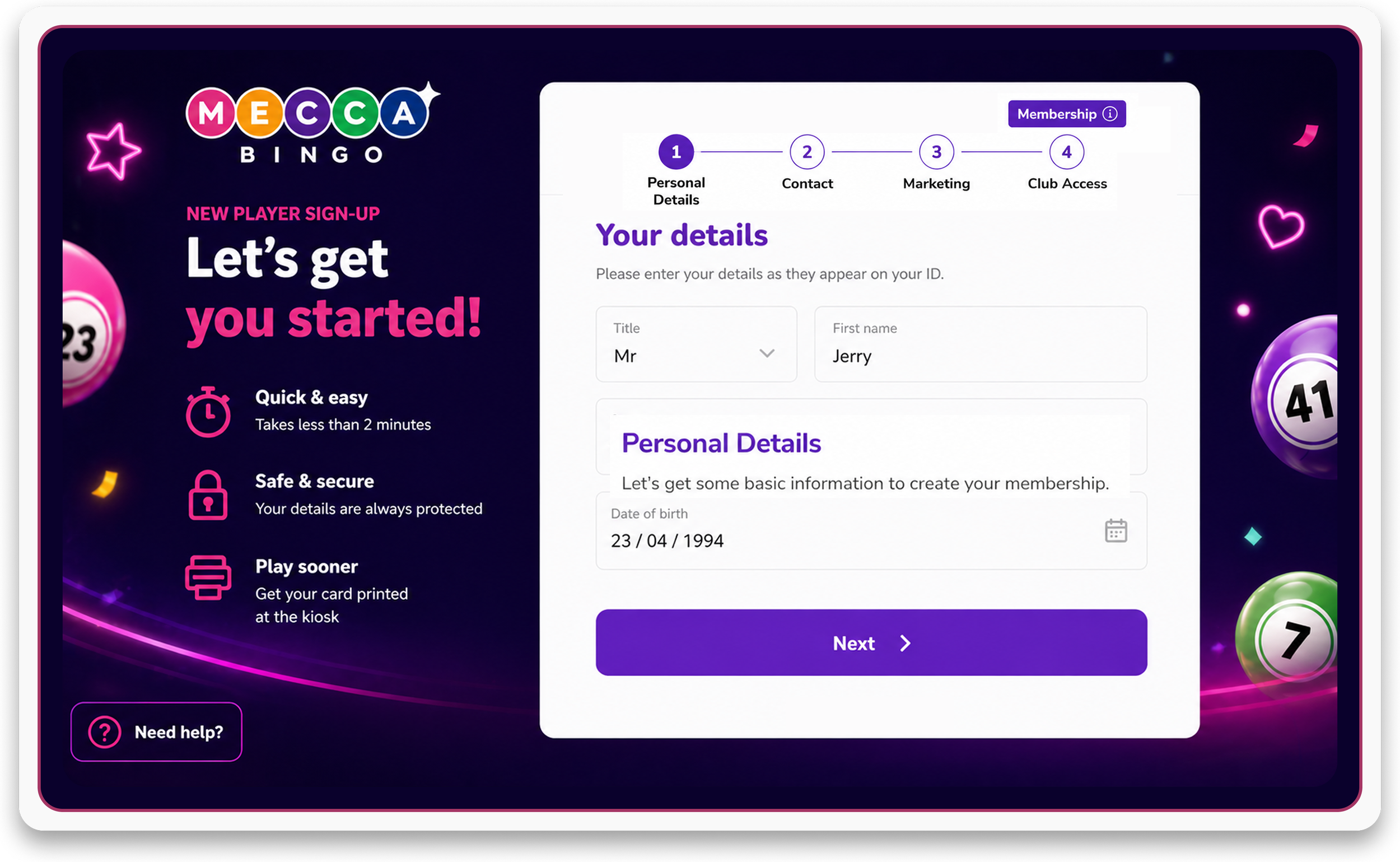
Short welcome screen → Simple 2-step form
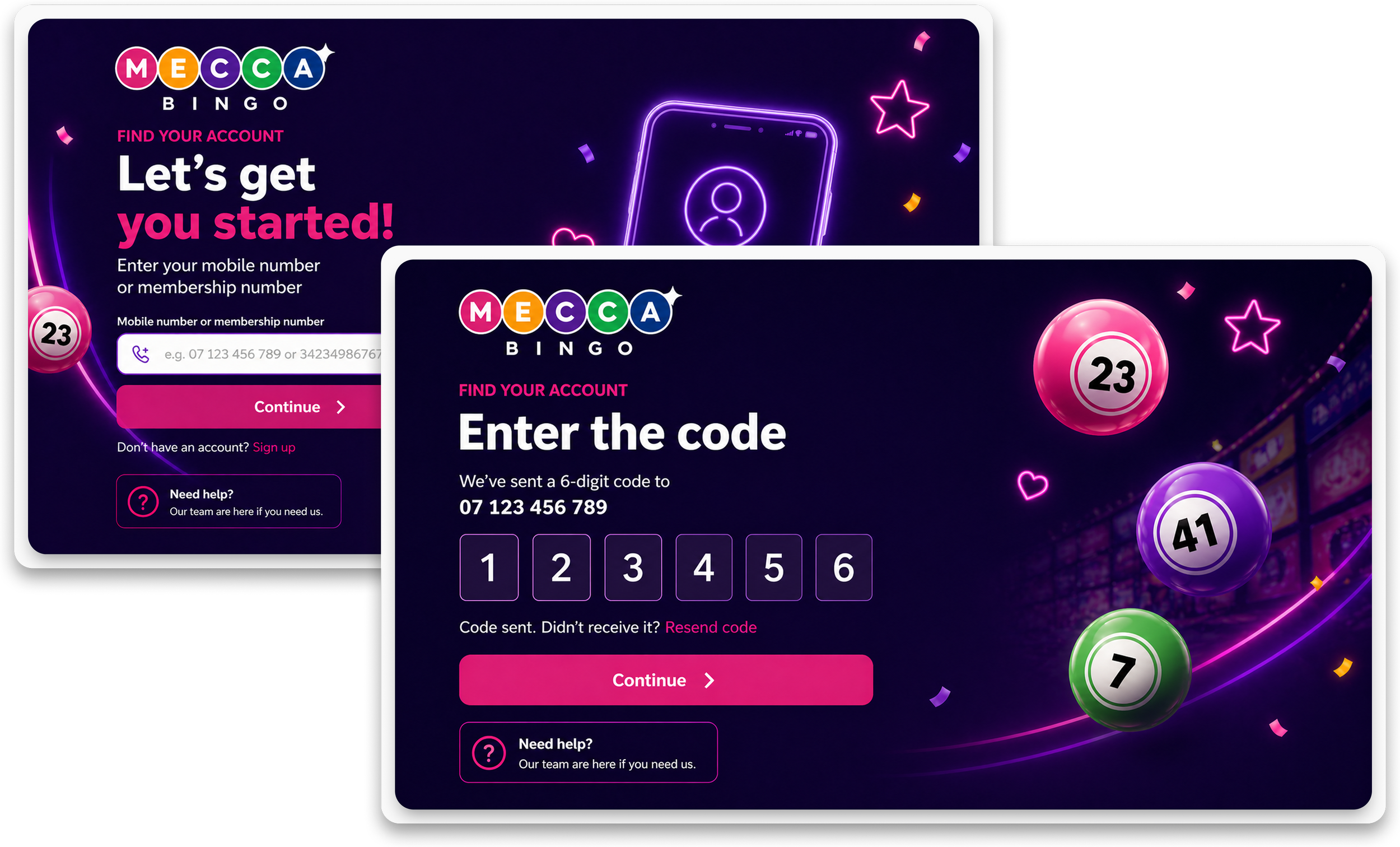
3. Existing player access
Returning players can find their account using their mobile or membership number, view their basic details, and access their membership.
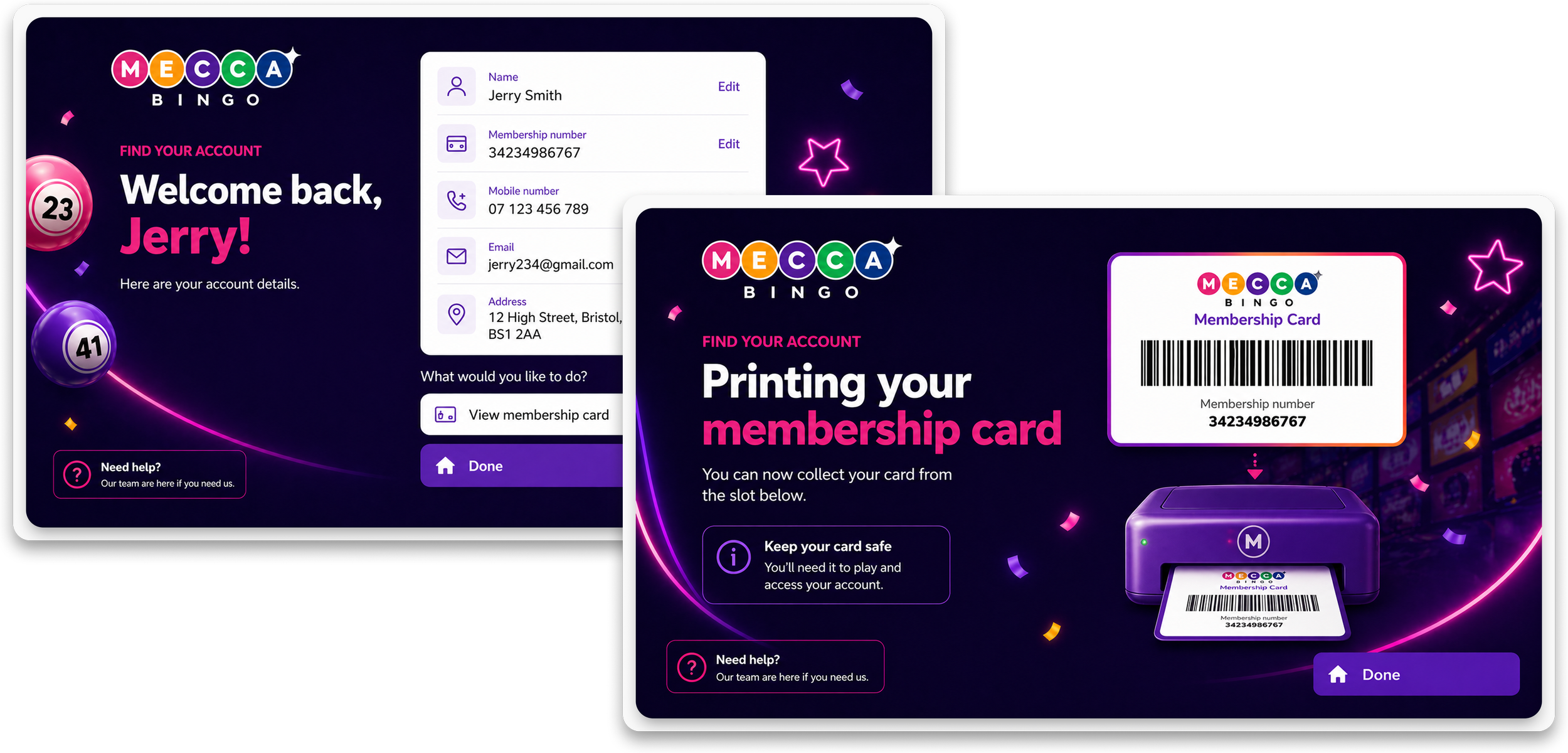
4. Print your own membership card
The Kiosk also provides a self serve option to print the membership card which completely eliminates the need for staff assistance.
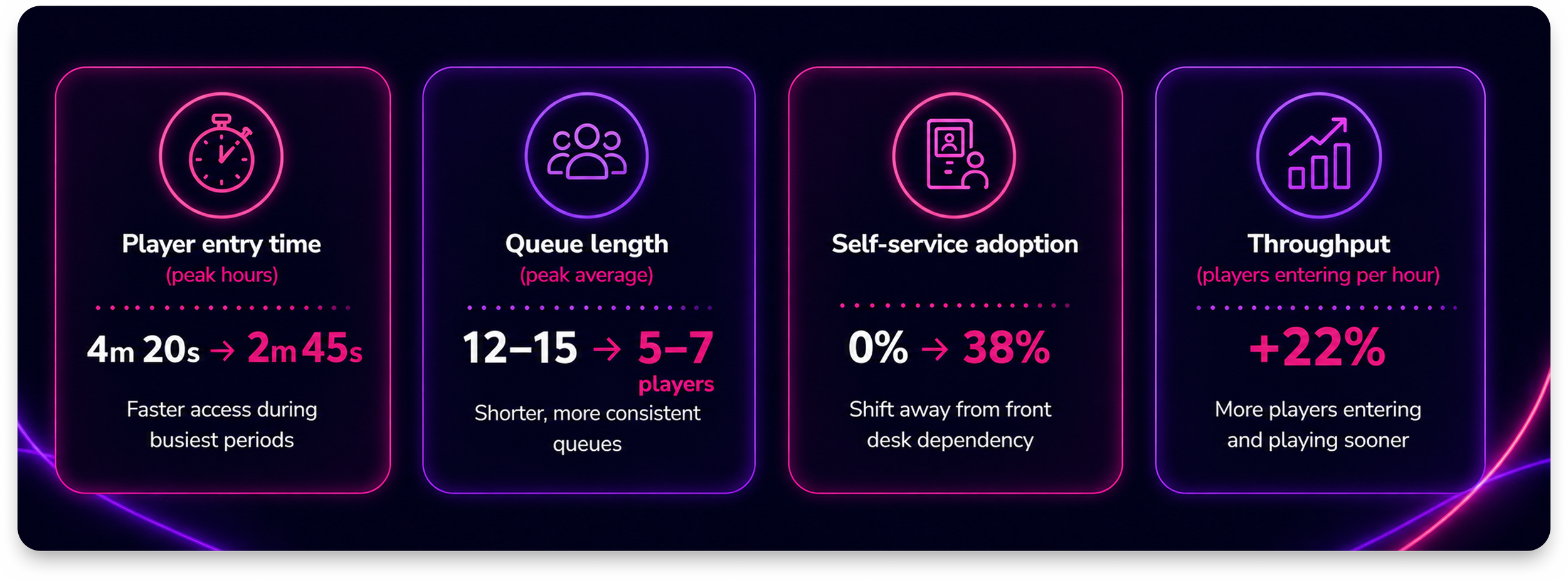
Key outcomes
The result was a faster, more scalable entry experience that reduced pressure on staff while getting players into the venue quicker.
Pilot to rollout
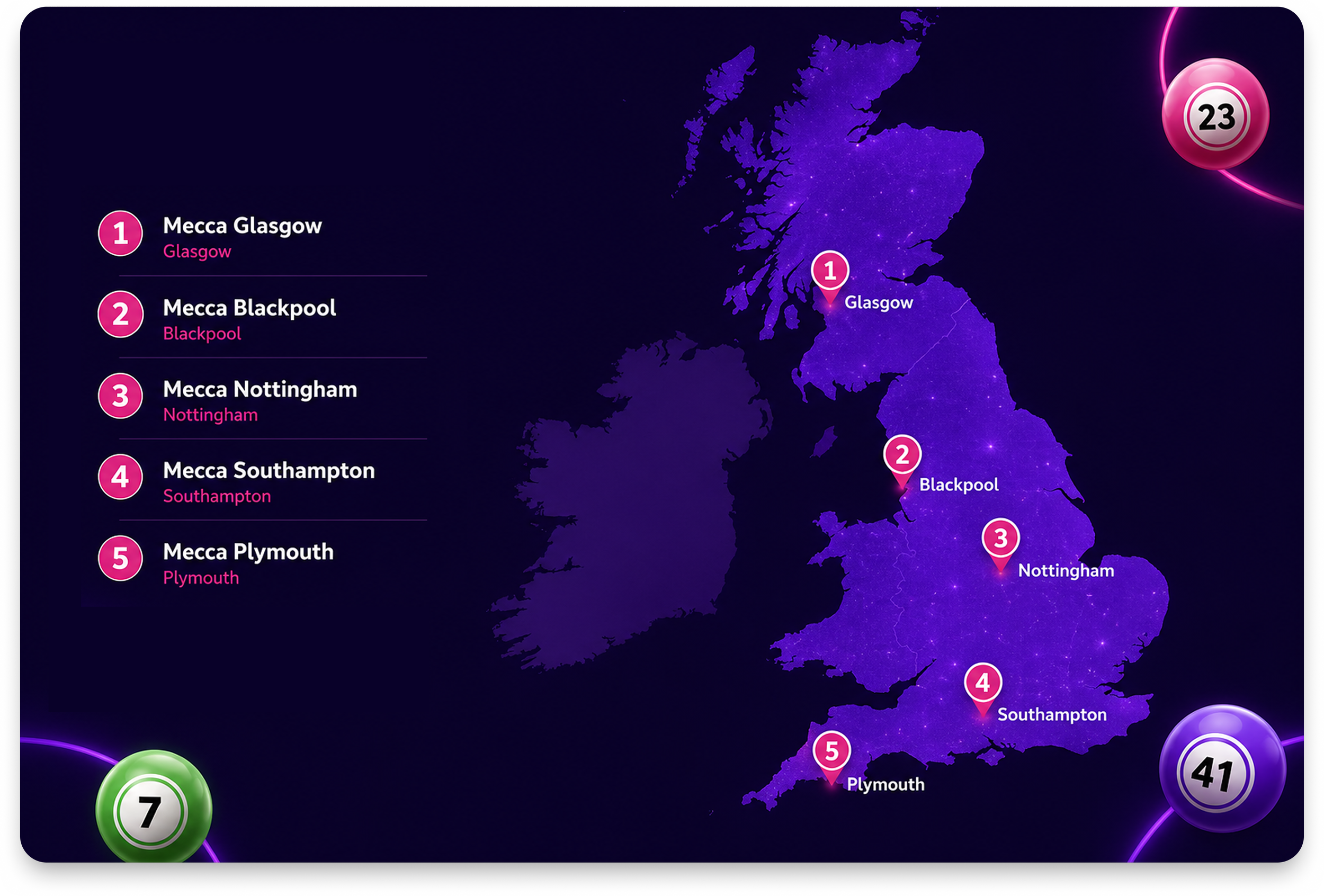
A 4-week pilot across 5 UK venues tested the new entry experience during peak periods, leading to a full rollout across 50+ venues.
Redesigning the bonus
engine to improve operational confidence
Transforming Rank’s internal promotion system to enable confident bonus campaign launches.