COGS Bonus Engine Redesign
Enabling safe, scalable promotion management across global platforms
RANK INTERACTIVE (WEB APPLICATION) | SENIOR PRODUCT DESIGNER (UX/UI)

EXECUTIVE SUMMARY
About (Why)
COGS 2.0 (Customer Operations & Gaming System) was a major internal transformation programme focused on modernising the legacy back-office architecture across multiple brands and regions. The initiative replaced fragmented tooling with a scalable, modular platform designed to improve governance, flexibility, and long-term maintainability.
Within this broader upgrade, the Bonus Engine, responsible for configuring promotions and incentives, represented a critical operational system with direct commercial and compliance implications.
The legacy engine functioned, but it was slow, error-prone, and heavily reliant on tribal knowledge. As promotional mechanics became more complex, operational risk increased. COGS 2.0 provided the architectural foundation to redesign the bonus engine properly, not just visually, but structurally.
Problem
The previous configuration experience introduced systemic friction:
Long-form setup created high cognitive load
Validation rules were unclear and inconsistently surfaced
Promotions frequently required post-launch correction
Teams relied heavily on manual QA and peer knowledge
Mental models between system logic and operational reality were misaligned
Confidence in correct setup was low (2.1/5 baseline)
In a high-risk promotional environment, these issues slowed campaign velocity and increased compliance exposure.
Solution
With the new backend capabilities unlocked by COGS 2.0, I led the redesign of the Bonus Engine to embed governance, clarity, and validation directly into the workflow.
The redesigned engine introduced:
A modular, step-based configuration journey
Real-time validation and constraint surfacing
Clear targeting logic visibility
Structured governance-aligned workflows
Improved alignment between system logic and user mental models
This transformed the tool from reactive error correction to proactive risk mitigation.
Deliverables
UX strategy aligned to COGS 2.0 transformation goals
End-to-end configuration architecture redesign
Validation and feedback framework
Cross-functional workshops across Product, Engineering, CRM, and Commercial teams
Pre- and post-launch internal survey to benchmark usability and confidence
Global rollout and adoption support
Impact
Following launch:
Ease of use increased from 2.3 → 4.2
Promotion corrections reduced from 64% → 18%
Configuration time reduced by 40%+
Manual QA dependency reduced by 48%
Confidence in setup accuracy increased from 2.1 → 4.4
The redesign reduced operational friction, strengthened governance clarity, and enabled global teams to operate with greater speed, consistency, and confidence.
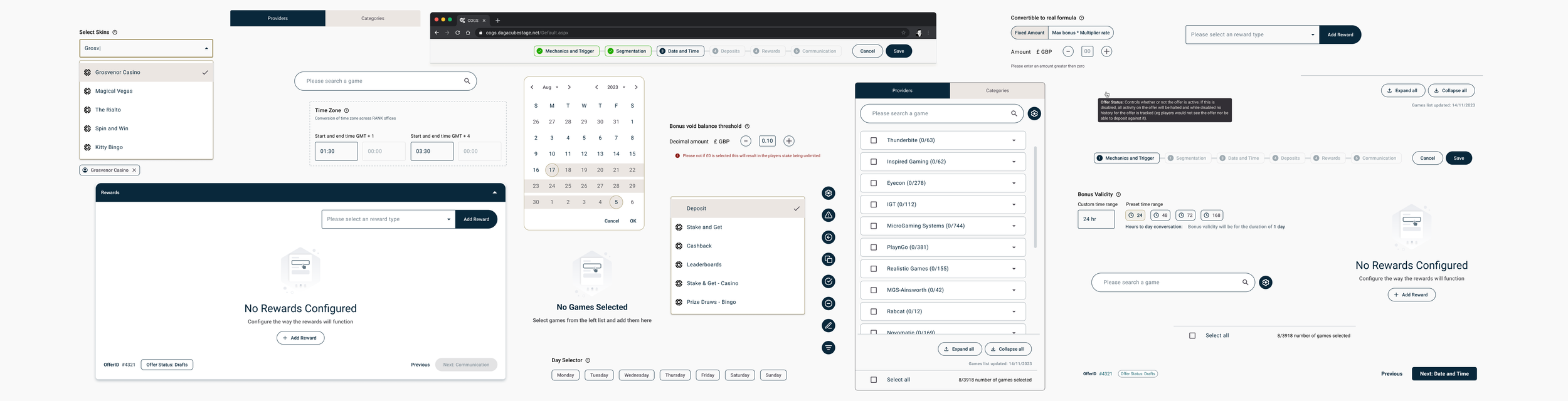
The redesign of the bonus engine was scoped to deliver high impact improvements in a critical system journey.
CONTEXT & CONSTRAINTS
The original COGS platform had evolved organically over years and through multiple acquisitions. While functional, it was never architected for scale. As promotional complexity increased, performance bottlenecks, slow task completion, and high configuration error rates became more visible across regions.
Teams operating across Cape Town, Mauritius, Gibraltar, and London experienced inconsistent workflows, duplicated effort, and delays — with some configuration journeys taking 2–10x longer than necessary. The broader COGS 2.0 programme introduced architectural improvements and a modernised backend, creating the technical foundation to address these systemic inefficiencies.
The Bonus Engine redesign was intentionally scoped as a high-impact intervention within a critical system journey. Broader promotional ecosystem redesigns, such as post-deposit bonus tracking or unrelated campaign workflows, were out of scope due to platform dependencies and phased engineering delivery.
Key Constraints
Governance & Compliance: Responsible gambling and regulatory compliance were non-negotiable. All interaction patterns and validation logic needed to reduce risk rather than introduce flexibility that could compromise control.
Backward Compatibility: The redesigned engine needed to remain compatible with existing live promotions while improving clarity and operational accuracy — limiting opportunities for structural disruption.
Global Collaboration & Adoption: Cross-regional teams operated asynchronously across multiple time zones. Workshops and alignment sessions required clear artefacts, self-explanatory flows, and documentation that supported remote understanding and consistent rollout.
ANALYSIS & DISCOVERY
To understand operational friction within the Bonus Engine, I conducted shadowing sessions, stakeholder interviews, internal data analysis, and a structured baseline survey across regional teams in Cape Town, Mauritius, Gibraltar, and London.
This approach allowed us to capture both qualitative behavioural patterns and measurable benchmarks before initiating redesign, ensuring the intervention addressed systemic risk, not just surface usability issues.
The analysis revealed several structural problems within the legacy long-form configuration:
Cognitive overload: All configuration fields were presented in a single monolithic form. Dependencies between inputs were unclear, and users struggled to determine which sections were relevant to specific promotion types. This increased decision fatigue and slowed task completion.
Delayed error feedback: Validation occurred only at final submission. Errors were surfaced late in the process, resulting in repeated rework cycles and unnecessary engineering support.
Implicit System Rules: Certain inputs triggered hidden logic elsewhere in the system. These side effects were not clearly surfaced, meaning successful configuration relied heavily on tribal knowledge and prior experience.
Confidence & Governance Gap: Teams lacked assurance that promotions were configured correctly before launch. This led to heavy reliance on manual QA and frequent engineering intervention, increasing operational risk in a compliance-sensitive environment.
DESIGN PRINCIPLES
From these insights, three guiding principles shaped the redesign and aligned stakeholders around a shared, risk-aware rationale.

1.Make rules and dependencies explicit:
System logic, constraints, and eligibility criteria must be clearly surfaced within the workflow.
Users should understand how inputs affect outcomes before committing, not after submission.

2.Design for safe failure:
The system should prevent invalid configurations through embedded validation and real-time feedback.
Reducing downstream operational and compliance risk was prioritised over flexibility.

3.Enable Confident Review & Validation:
Users must be able to explore, review, and confirm configurations independently.
The experience should minimise rework and remove reliance on tribal knowledge or engineering intervention.
SOLUTION OVERVIEW
The Bonus Engine was redesigned as a modular, step-based configuration journey, replacing the legacy monolithic form with a structured workflow that reduced cognitive load and embedded validation directly into the experience.
The objective was not simply simplification, but the reduction of operational risk through clarity, governance, and real-time feedback.
Key improvements included:
1. Step-based flow:
The long-form setup was broken into six structured stages:
Mechanics & Triggers → Segmentation → Date & Time → Deposit → Rewards → Communications & Info
Each stage introduced contextual validation, surfacing constraints early and preventing invalid configurations before submission.
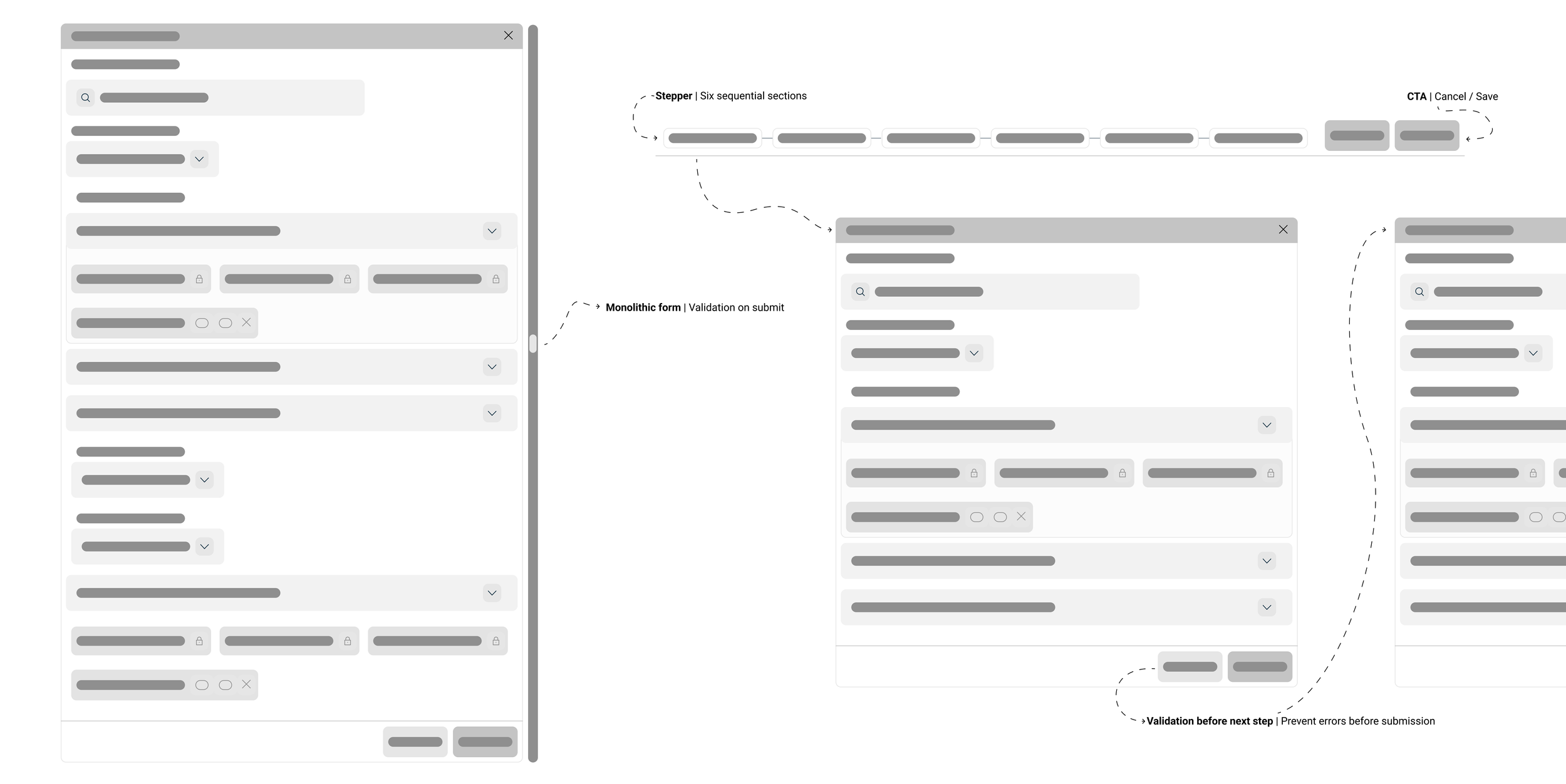
2. Safe & Guided Decision-Making
Warnings, tooltips, and in-line system feedback highlighted conflicts and rule dependencies as users progressed.
Teams could review, correct, and confirm configurations step-by-step, significantly reducing rework and post-launch corrections.
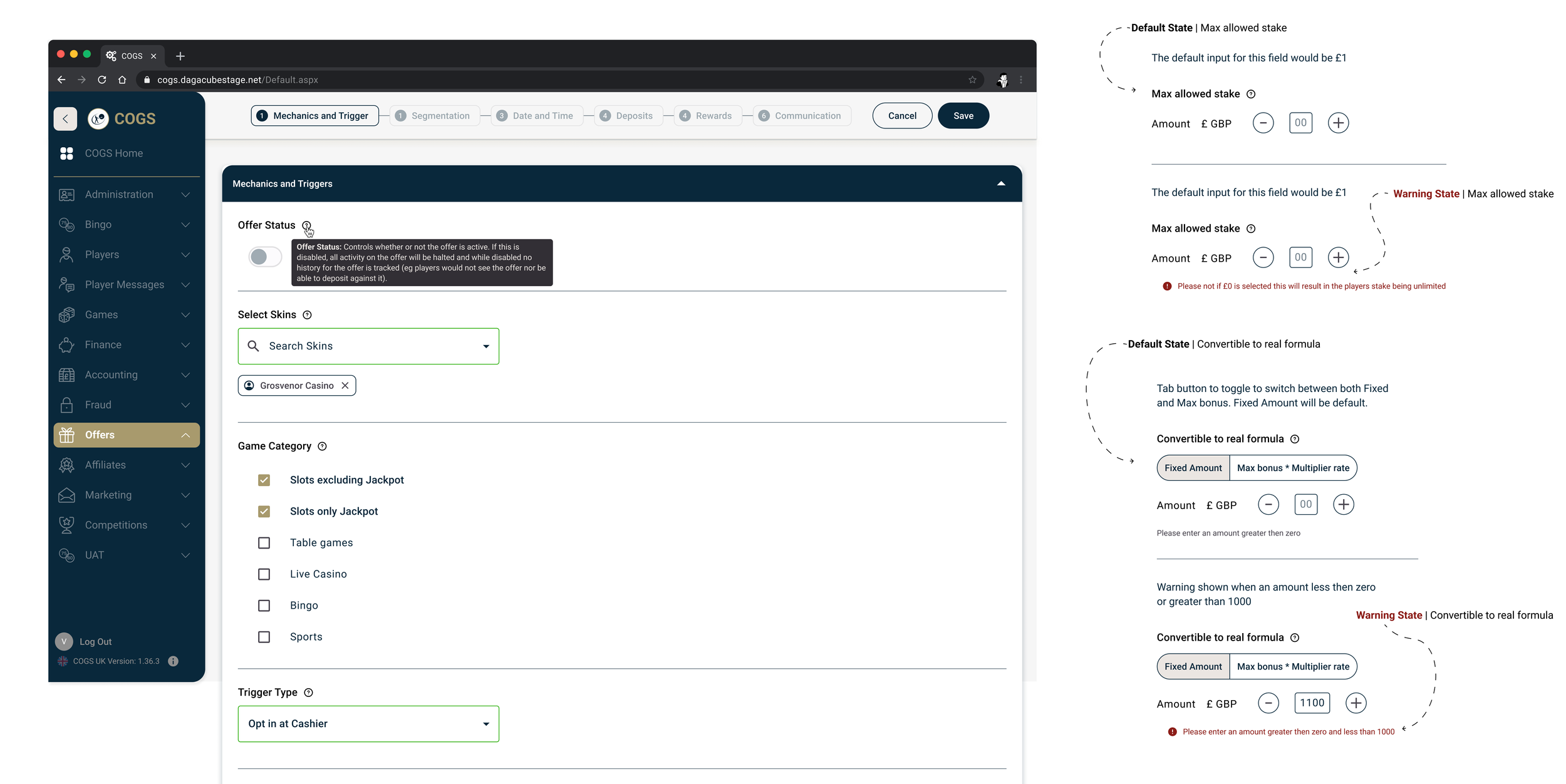
3. Explicit Constraints & Eligibility Logic
All system rules and dependencies were surfaced directly within the interface.
Users could clearly see required inputs, eligibility conditions, and downstream effects, removing reliance on tribal knowledge.
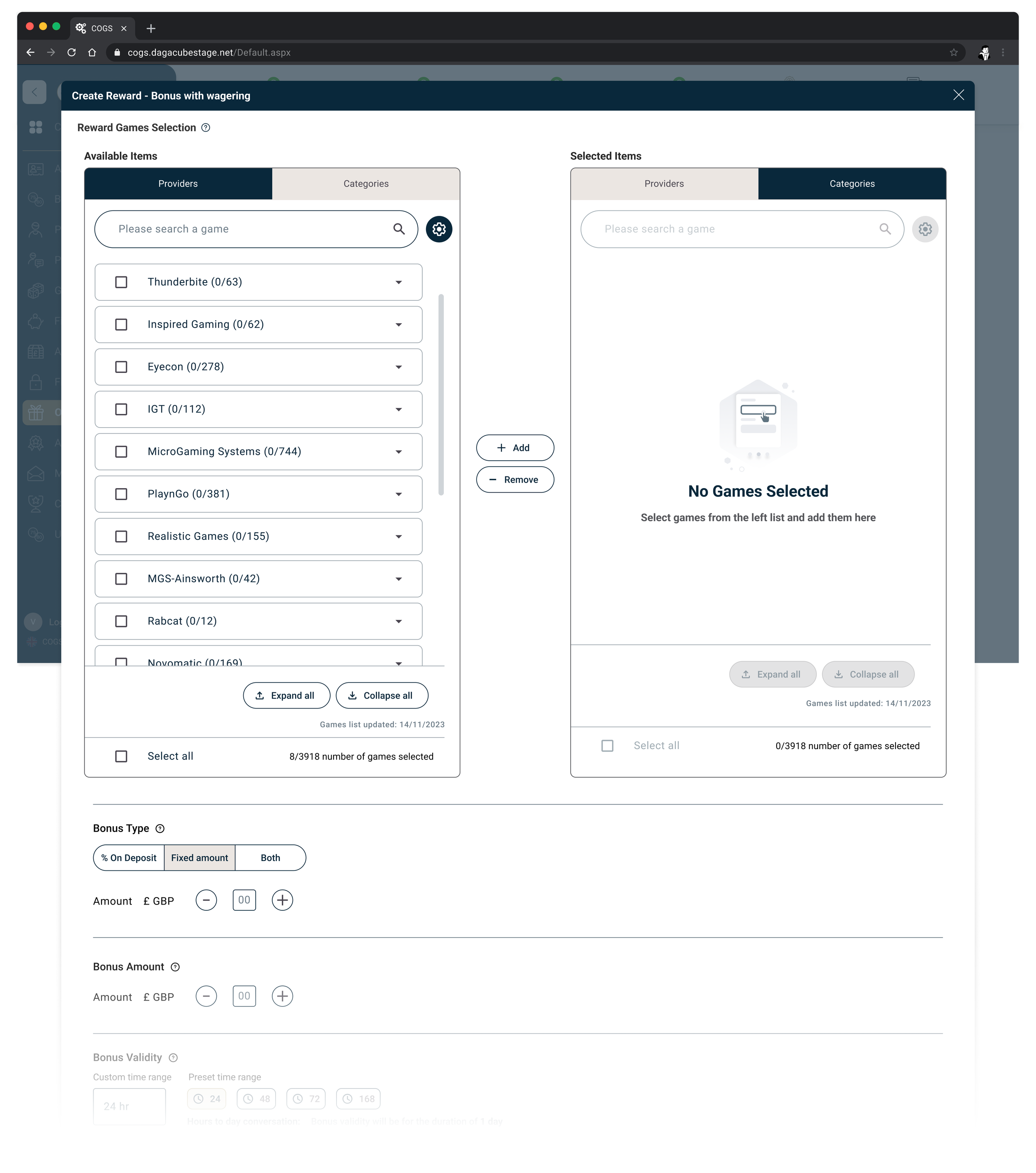
The Rewards section was designed as a dynamic interface, surfacing only the fields required to complete the configuration based on earlier inputs. The system logic draws from the preceding stages, Mechanics & Triggers, Segmentation, Date & Time, and Deposit criteria, to determine which options are relevant and valid.
For example, within Segmentation, users can define depositor type (e.g., first-time, repeat), select device categories (desktop, mobile, or both), and upload specific player IDs for targeted campaigns. These selections dynamically shape the Rewards configuration, mapping available games and eligibility rules directly to the defined audience parameters.
As a result, fields such as bonus type, amount, and validity are only presented when applicable to the selected depositor segment, ensuring that users are guided by contextual logic rather than navigating irrelevant options.
What This Solved
Reduced cognitive load by removing irrelevant fields
Prevented invalid reward configurations through contextual logic
Improved targeting accuracy and user confidence
Eliminated reliance on implicit knowledge when setting rewards
4. Scalable Architecture
The redesigned structure aligned with the COGS 2.0 backend modernisation.
The modular UI and validation framework were built to support new mechanics, business rules, and promotional models without requiring repeated engineering rework.
VALIDATION, OUTCOMES & IMPACT
To ensure the redesign delivered measurable improvement, we conducted a structured internal survey before launch and repeated the same assessment post-release. This allowed us to benchmark usability, efficiency, and operational confidence with consistent metrics.
Validation Approach
We measured:
Ease of use (1–5 scale)
Configuration time
Error frequency and correction rate
Confidence in setup accuracy
Reliance on manual QA checks
By capturing both behavioural and perception-based data, we were able to validate real operational change — not just subjective improvement.
Outcomes
Following launch:
Ease of use increased from 2.3 → 4.2
Promotion corrections reduced from 64% → 18%
Configuration time reduced by 40%+
Manual QA dependency reduced by 48%
Confidence in setup accuracy increased from 2.1 → 4.4
These results confirmed that the redesigned workflow reduced friction, improved clarity, and significantly lowered operational risk.
Impact
Beyond usability gains, the redesign materially improved how teams operated:
Reduced operational friction across CRM and Commercial teams
Strengthened targeting confidence and governance clarity
Accelerated campaign deployment timelines
Increased internal adoption and system trust
COGS 2.0 transformed the Bonus Engine from a reactive, error-prone tool into a scalable, validated system supporting commercial growth and compliance integrity.
REFLECTION
Redesigning the Bonus Engine reinforced that internal systems deserve the same measurement rigor as customer-facing products.
Introducing structured pre- and post-launch benchmarking allowed us to move beyond anecdotal feedback and quantify meaningful improvements in usability, confidence, and operational efficiency. The results demonstrated that clarity, embedded validation, and structured workflows can materially reduce risk and increase system trust.
A key learning was that adoption is driven as much by confidence as by simplification. Internal teams need visibility, explicit constraints, and measurable success criteria to operate effectively, particularly in compliance-sensitive environments.
If revisiting the project, I would extend the validation framework by embedding ongoing performance tracking directly into the tool, surfacing real-time error rates and usability signals to support continuous optimisation beyond launch.
First-Time Deposit Journey
Redesigning a critical moment to increase confidence, clarity, and conversion

Player Management System
Reducing friction and decision fatigue in high-frequency player management tasks