Improving first-time deposit conversion by reducing user uncertainty
Designing clarity at the moment users commit real money led to measurable improvements in conversion, trust, and operational efficiency.
GROSVENORCASINO APP & WEB | SENIOR PRODUCT DESIGNER (UX/UI)

Introduction
Grosvenor Casino is part of The Rank Group, one of the UK’s largest gambling and entertainment companies.
The digital platform serves 1.7M customers annually, generating over £200M in digital revenue.
Context.
For new players, the first deposit represents the moment they move from exploring the product to committing real money.
It is also one of the most commercially critical moments in the player lifecycle, directly impacting acquisition performance and long-term player value.

To encourage deposits, players are typically offered a welcome bonus additional funds or free play awarded after their first payment.

These rewards are governed by eligibility rules and wagering requirements that determine how and when players receive value.
While the system behind these promotions is deterministic, it is not always visible to players creating a gap between system behaviour and user expectations.
The Problem
Internal data and customer support signals indicated that the first-time deposit journey was generating significant confusion around promotional rewards.
Bonus-related queries averaged 2,200+ support cases per month, with many users believing their reward had not been applied correctly.
The issue was not friction in the payment flow, but a lack of clarity in how bonuses worked particularly how they related to deposits and when rewards would be received.
As a result, users reached payment without a clear understanding of the value, leading to hesitation, support dependency, and reduced confidence.
Problem to solve.
How might we make the value exchange of the first-time deposit clear and predictable so users understand what they will receive, when they will receive it, and can complete their deposit with confidence?
Discovery
While the data highlighted confusion around promotional rewards, it did not explain where or why this breakdown was occurring within the journey.
The goal of discovery was to understand how users formed expectations around bonuses, where those expectations broke down during the first-time deposit flow, and how the underlying system applied and delivered rewards in practice.
Discovery Activities.
To understand how users interpreted promotional value and where confusion was introduced, discovery combined support insights, journey analysis, behavioural observation, and system review.

A clear view of where value broke down across the deposit experience.
Discovery Outcome.
The issue was not a single point of friction, but a breakdown in how value was communicated across the journey.
Users formed expectations early but lacked clarity at key decision points, leading to hesitation at the point of deposit.
Addressing this required making the value exchange explicit linking deposit, bonus, and reward.
To pinpoint where this breakdown occurred, the experience was analysed across three perspectives: support insights, journey analysis, and system understanding.
Support insights.
Created to address: lack of visibility into how users experienced and described issues with promotional rewards.
What it does: support cases were analysed to identify recurring themes in bonus-related queries, focusing on how users understood reward eligibility, application, and timing.
This revealed consistent patterns of:
Perceived missing rewards
Misunderstood bonus conditions
Unclear reward states
Across an eight-month period, 18,160 support cases were recorded for the sign-up bonus, averaging 2,270 cases per month.
Outcome.
Exposed the gap between user expectation and system behaviour
Identified where value communication was breaking down
Grounded the problem in real user language and behaviour
Journey analysis.
Created to address: unclear points within the deposit flow where user expectations broke down.
What it does: the end-to-end journey was mapped to identify where value was introduced, how it was communicated, and where uncertainty emerged.
This focused on:
Offer selection and expectation setting
Payment method selection and compatibility
Deposit confirmation and reward outcome
Journey mapping
Outcome.
Identified key moments where confusion was introduced
Highlighted gaps between information and decision points
Defined critical stages for improving clarity and confidence
Understanding the system.
Created to address: mismatch between user expectations and how the system applied and delivered rewards.
What it does: the bonus system logic was analysed to understand how deposits, eligibility conditions, and rewards were processed and delivered.
This made visible:
How bonuses were triggered
When rewards were applied
Where delays or ambiguity occurred
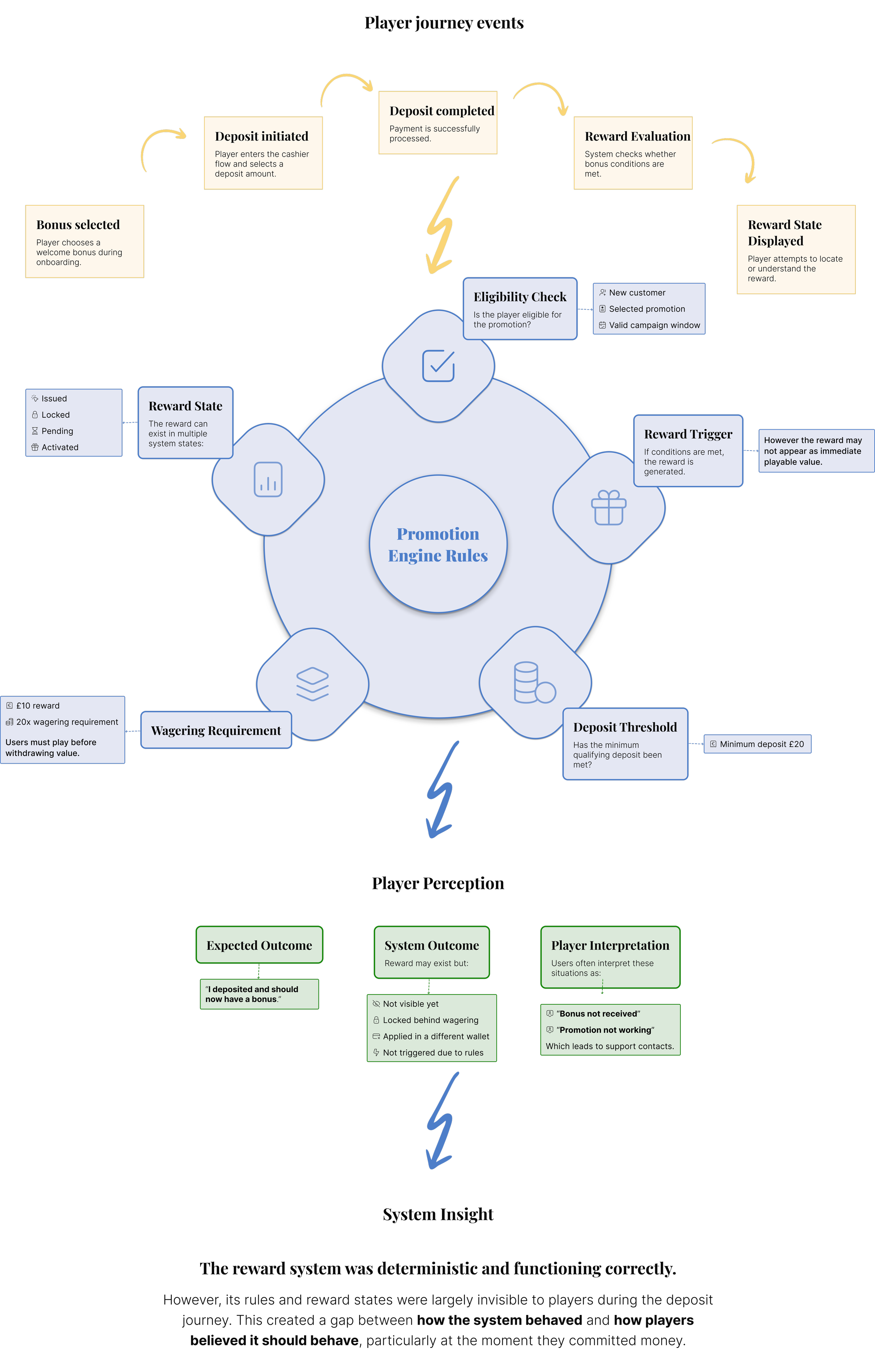
Bonus reward system.
How the promotion engine determines bonus outcomes
Outcome.
Clarified how the system translated deposits into rewards
Identified gaps between system behaviour and user expectations
Informed how value should be communicated within the experience
DESIGN STRATEGY.
The discovery phase showed that the issue was not friction alone, but a lack of clarity in how value was communicated and understood at the point of deposit.
The approach focused on three principles:
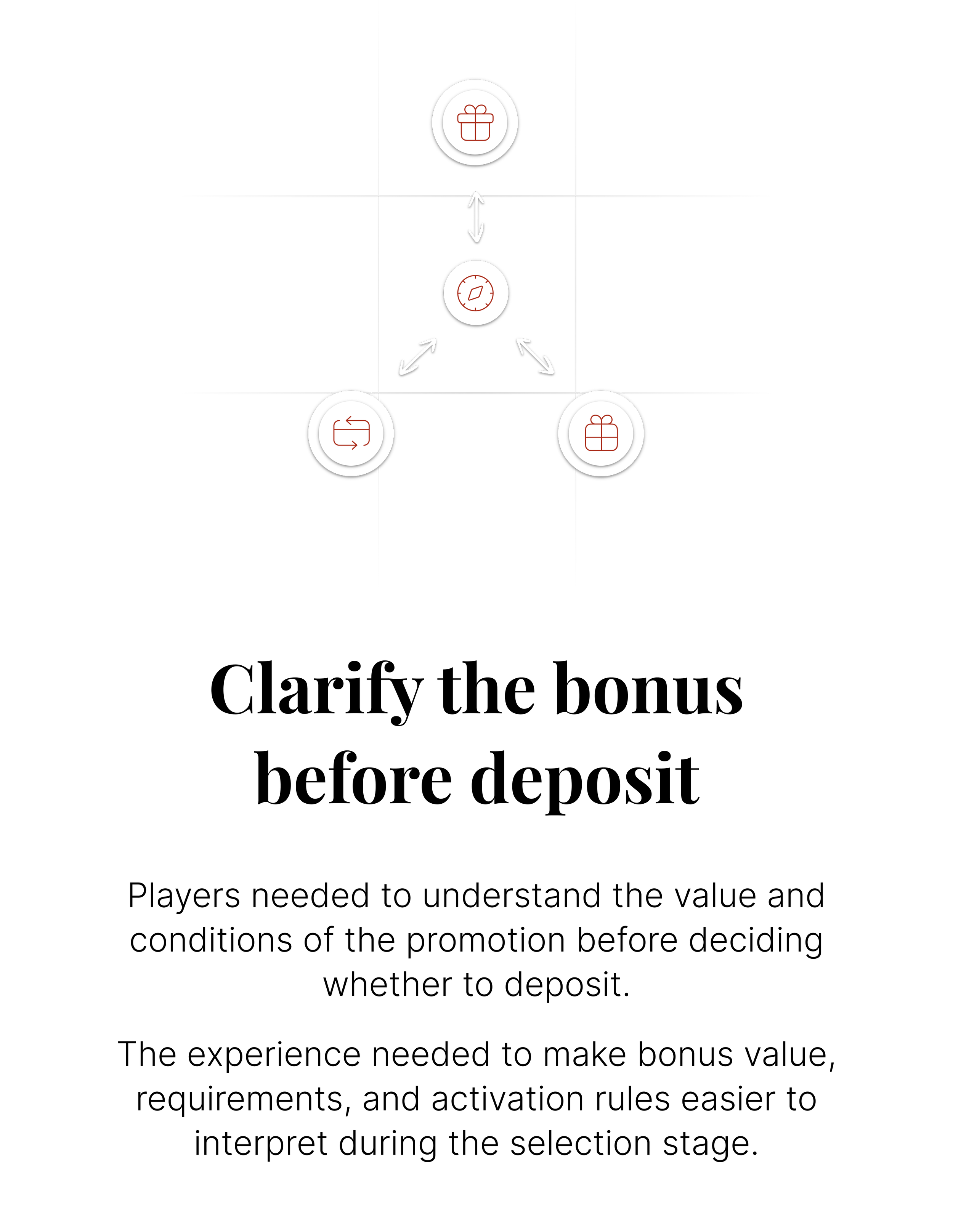
Strategic direction.
The solution focused on improving these moments within the deposit experience itself, allowing the team to address the most critical confidence gaps without redesigning the entire onboarding journey.
The final experience therefore focused on reinforcing confidence across three critical moments of the deposit journey:
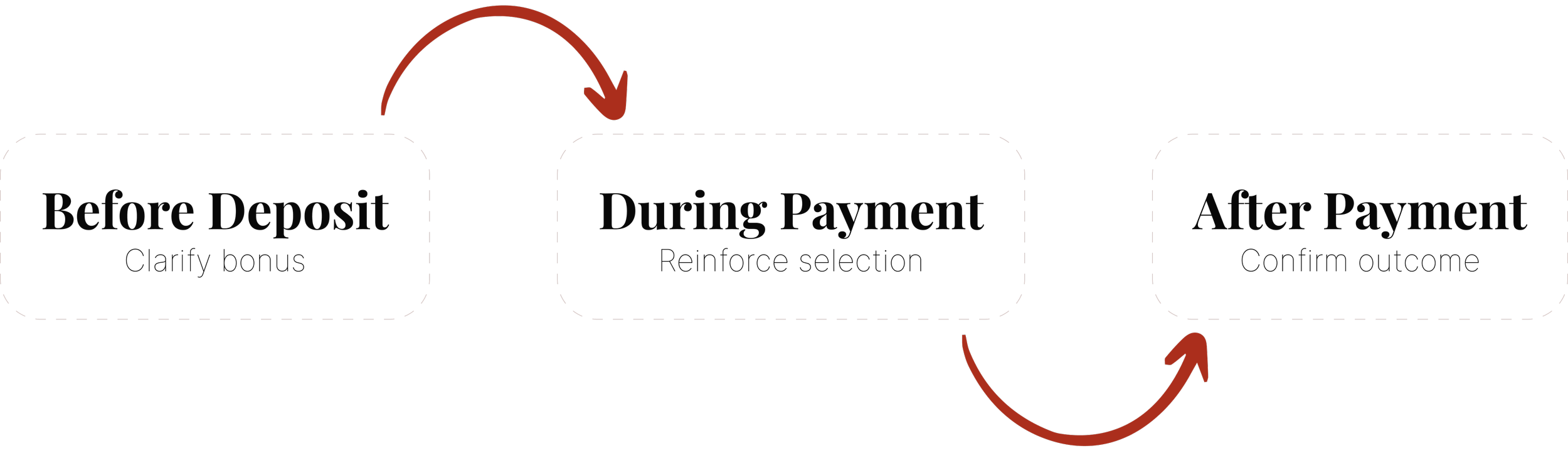
These moments occurred within or immediately around the cashier experience, making the deposit flow the highest-impact area to address first.
SOLUTION
The final experience focused on reinforcing confidence across the three moments where journey analysis showed expectations breaking down.
Design decisions were therefore structured around the deposit journey itself: before the transaction, during payment, and immediately after confirmation.
Before deposit.
Problem: players struggled to understand what the selected bonus actually meant before committing money.
Key conditions such as wagering requirements and reward activation were not always clear during selection.
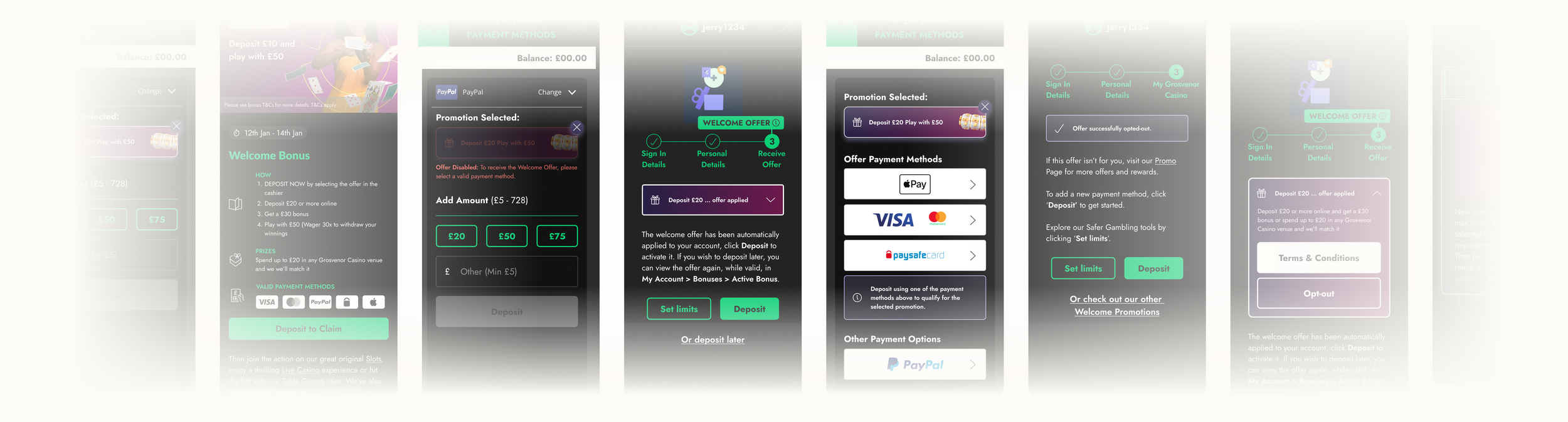
Design decision: the bonus selection experience was redesigned to make reward value, eligibility rules, and wagering conditions easier to interpret before entering the cashier.
Registration flow: Step three (The reward).
Promotion / Bonus screen.
Outcome.
By clarifying reward mechanics at the point of selection, players could make a more confident decision before entering the deposit flow.
During payment.
Problem: as players moved into the cashier flow, visibility of the selected bonus weakened, creating uncertainty at the moment they were asked to commit payment.
Design decision: the cashier experience reinforced the selected bonus throughout the payment flow, allowing players to verify the reward while entering payment details.
Payment method.
Deposit flow.
Outcome.
Maintaining visibility of the active reward reduced uncertainty during the transaction and helped reinforce trust in the outcome.
After payment.
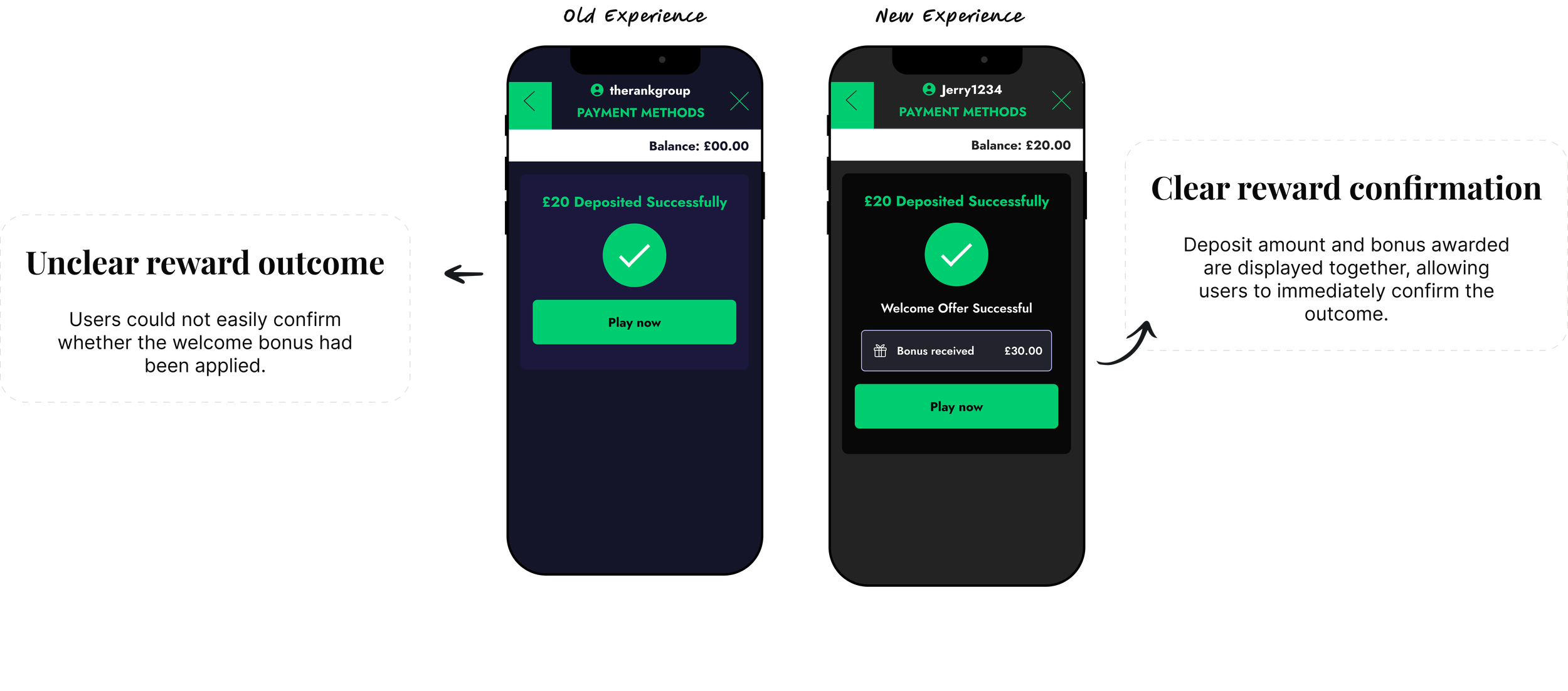
Problem: after completing the transaction, players often struggled to confirm whether the bonus had been applied correctly.
Design decision: confirmation screens were redesigned to clearly communicate reward status and next steps after deposit.
Deposit successful.
Outcome.
Clear feedback after the transaction helped players understand the reward outcome without needing to contact support.
The redesigned journey reinforced confidence across the entire deposit experience by making reward behaviour visible at the moments players needed it most.
This reduced uncertainty before committing payment and helped players clearly understand the reward outcome after deposit.
Impact
The redesign focused on improving clarity and confidence at the moment of commitment. Success was measured across behavioural outcomes, user understanding, and operational efficiency to ensure the changes delivered meaningful impact beyond interface improvements.
Behavioural impact.
A four-week A/B test targeting 10% of new sign-ups validated the approach before full rollout.
Key outcomes.
+7pp increase in first-time deposit completion
-6pp reduction in abandonment
+8pp increase in bonus activation
These results confirmed that improving clarity directly influenced user behaviour at the moment of commitment.
Experience impact.
Users required fewer interactions to understand bonus mechanics, and post-deposit uncertainty decreased substantially.
Key outcomes.
• Users unsure if the bonus was applied reduced from 26% → 12%
• Time to complete deposit decreased by ~19%
• Bonus help interactions reduced by ~30%
Together, these changes showed that the redesigned experience improved users’ understanding of both value and outcome.
Operational impact.
Support data showed a sustained decline in bonus-related queries following rollout, particularly in the largest category of confusion-driven contacts.

These reductions demonstrate that improved clarity translated directly into operational efficiency and reduced support reliance.
Redesigning the bonus engine to improve promotion configuration and operational confidence
Improving clarity, governance, and efficiency for high-risk promotion configuration
Player Management System
Reducing friction and decision fatigue in high-frequency player management tasks