Defining Metabolic Shift
Facilitating a 4-Day Product Definition Sprint
PRODUCT DISCOVERY & MVP DEFINITION | SENIOR PRODUCT DESIGNER
EXECUTIVE SUMMARY
About Metabolic Shift
Metabolic Shift was an early-stage product concept exploring how a digital companion could help users fast more consistently and safely through real-time metabolic guidance.
Before moving into design or development, the team needed clarity on the behavioural problem, the product’s differentiation, and what success would look like. I led a structured 4-day product definition sprint to align stakeholders, surface risks, and define a focused MVP grounded in behavioural insight.
The sprint brought together Product, Engineering, Growth, and Data to move from ambiguity to a shared product direction and measurable learning plan.
Problem
The team had strong belief in the opportunity, but there was no shared understanding of:
The real user problem
How the product would differentiate from existing fasting apps
Which behaviours we were trying to change
What success looked like
Early discussions were drifting toward features rather than outcomes, creating a risk of building a solution that wouldn’t meaningfully impact user behaviour.
Without alignment, we risked investing time and engineering effort into a product that solved the wrong problem.
Solution
I designed and facilitated a 4-day cross-functional sprint to create clarity, reduce risk, and define a behaviour-driven MVP.
The sprint was structured to progressively move the team from understanding to decision-making:
Day 1 — Alignment & Problem Framing
We aligned on the target user, core tension, strategic constraints, and success metrics, surfacing key assumptions and risks.
Day 2 — Insight & Behavioural Context
Through market analysis, behavioural signals, and emotional journey mapping, we identified where uncertainty and decision conflict occurred during the fasting experience.
Day 3 — MVP Definition
Using a MoSCoW prioritisation workshop and experience blueprint, we defined a focused MVP designed to validate our core hypothesis.
Day 4 — Measurement & Experimentation
We established a success framework, instrumentation plan, and decision model to ensure the MVP would generate actionable learning post-launch.
This approach ensured the product direction was grounded in behavioural insight rather than feature assumptions.
Deliverables
By the end of the sprint, the team had a clear and actionable product foundation:
Validated problem statement and behavioural hypothesis
Market landscape and opportunity gaps
Emotional journey map highlighting key intervention moments
Design principles to guide future execution
Clearly scoped MVP aligned to the core hypothesis
Experience blueprint mapping key product moments
Measurement framework with North Star metric and guardrails
Experimentation and decision plan
These artefacts created a shared understanding across disciplines and provided a strong foundation for design and development.
Impact
The sprint transformed an ambiguous product idea into a clear, testable direction.
1. Strategic Impact
The team shifted from feature exploration to hypothesis-driven product thinking, aligning around behaviour change rather than functionality.
2. Team Alignment
Stakeholders left with a shared understanding of the problem, the opportunity, and the path forward, reducing the risk of misaligned execution.
3. Product Clarity
The MVP scope provided engineering with a focused build target, while the measurement plan ensured we could evaluate impact and iterate confidently.
4. Decision Confidence
By defining success criteria upfront, the team was equipped to treat the MVP as a learning experiment rather than a one-time release.


PROCESS BREAKDOWN
Structuring the Sprint
The goal of the sprint was to create clarity before committing to design or build. Rather than jumping into solutions, I structured the sprint to progressively move the team from understanding the problem to defining a measurable product direction.
Each day focused on a specific outcome, ensuring we built shared understanding first, then translated insights into decisions.
DAY 1 — ALIGNMENT & PROBLEM FRAMING
Why This Step Mattered
Early conversations revealed different interpretations of the problem across stakeholders. Without alignment, we risked designing a solution based on assumptions rather than a shared understanding of user needs.
What We Did
I facilitated a series of workshops to:
Align on the target user and context
Surface individual perspectives on the problem
Identify strategic constraints (safety, technical, business)
Define a behaviour-driven success metric
Map key assumptions using an impact vs uncertainty framework
Outcome
By the end of Day 1, the team had:
✔ A shared problem statement
✔ A clear behavioural hypothesis
✔ Visibility of key risks
✔ Alignment on what success looked like
This created a strong foundation for the rest of the sprint.
DAY 2 — INSIGHT & BEHAVIOURAL CONTEXT
Why This Step Mattered
To design a meaningful solution, we needed to understand both the market landscape and the behavioural drivers influencing user decisions.
This step ensured we were solving a real behavioural problem rather than replicating existing patterns.
What We Did
We explored the category through:
Market landscape review to identify gaps
Directional behavioural signals to understand drop-off patterns
Emotional journey mapping to uncover moments of uncertainty
Hypothesis generation to connect insights to product direction
Definition of design principles to guide future decisions
Outcome
We identified two critical moments where the product could create the most value:
⭐ The 12–24 hour reassurance phase
⭐ The 36–42 hour decision phase
These insights reframed the product from a tracking tool to a decision-support experience.
DAY 3 — MVP DEFINITION
Why This Step Mattered
With insights in place, the next step was to define the smallest product that could validate our hypothesis. This prevented scope creep and ensured focus on behaviour change rather than feature completeness.
What We Did
I facilitated a prioritisation workshop that included:
Feature brainstorming to capture all ideas
MoSCoW prioritisation to define MVP scope
Experience blueprint mapping to visualise the end-to-end journey
Outcome
We defined a focused MVP centred around:
Real-time metabolic guidance
Decision support at key moments
Safety onboarding and guardrails
This gave the team a clear and achievable build target.
DAY 4 — MEASUREMENT & EXPERIMENTATION
Why This Step Mattered
The purpose of the MVP was to validate behaviour change, not simply deliver features. Establishing a measurement framework ensured we could evaluate whether the product achieved its intended impact.
What We Did
We defined:
The primary behavioural hypothesis
A North Star metric and supporting metrics
Safety guardrails to monitor risk
Instrumentation requirements for analytics
A decision framework outlining next steps based on results
Outcome
The MVP was positioned as a learning experiment with clear success criteria, enabling the team to move forward with confidence and a shared understanding of how to evaluate impact.
KEY ARTIFACTS & VISUALS
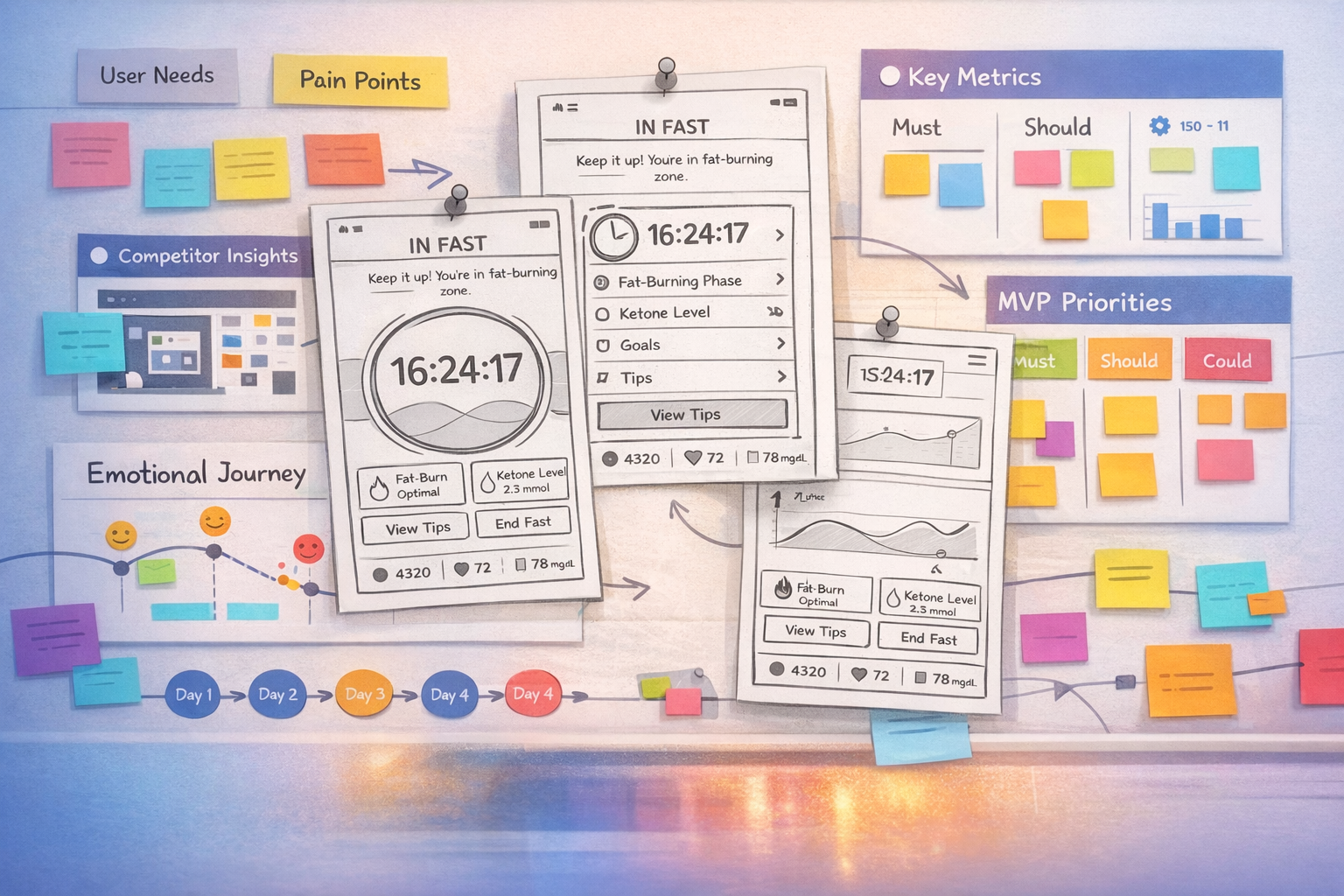
Throughout the sprint, I created a series of collaborative artefacts to align the team, surface insights, and support decision-making. These included problem framing workshops, behavioural mapping, MVP prioritisation, and a measurement framework.
Together, these artefacts document how the team moved from an initial concept to a clearly defined product direction grounded in behavioural insight.
Rather than presenting each exercise individually, the full FigJam board is available below for those interested in exploring the process in detail.
Sprint Board
This board captures the evolution of thinking across the four days, including workshop outputs, key decisions, and the artefacts that shaped the final MVP direction.
WHAT THIS DEMONSTRATES
This sprint reflects how I approach early-stage product challenges: by creating clarity before committing to solutions.
Rather than jumping into design, I focused on aligning stakeholders around the right problem, surfacing behavioural insights, and defining a measurable direction. The outcome wasn’t just a set of artefacts, it was shared confidence in what to build, why it mattered, and how success would be evaluated.
This work highlights my ability to:
Facilitate cross-functional alignment in ambiguous spaces
Translate complex discussions into clear decisions
Balance user needs with business, technical, and safety considerations
Define strategy and success criteria before execution
Use structured frameworks to reduce product risk
Ultimately, this sprint demonstrates how I contribute beyond interface design, by helping teams move from ideas to informed, outcome-driven product decisions.
First-Time Deposit Journey
Redesigning a critical moment to increase confidence, clarity, and conversion

Bonus Engine Redesign
Improving clarity, governance, and efficiency for high-risk promotion configuration