Redesigning the bonus engine to improve promotion configuration and operational confidence
Transforming a complex internal promotion system into a structured configuration experience that improves clarity, reduces operational risk, and enables teams to launch campaigns with confidence.
RANK INTERACTIVE (WEB APPLICATION) | SENIOR PRODUCT DESIGNER (UX/UI)

The Rank Group is a FTSE-listed international gambling and entertainment company operating physical venues and digital platforms across the UK and Europe.
With over 7,700 employees and 3.1 million active customers, its internal systems support a business generating nearly £800M in annual net gaming revenue.
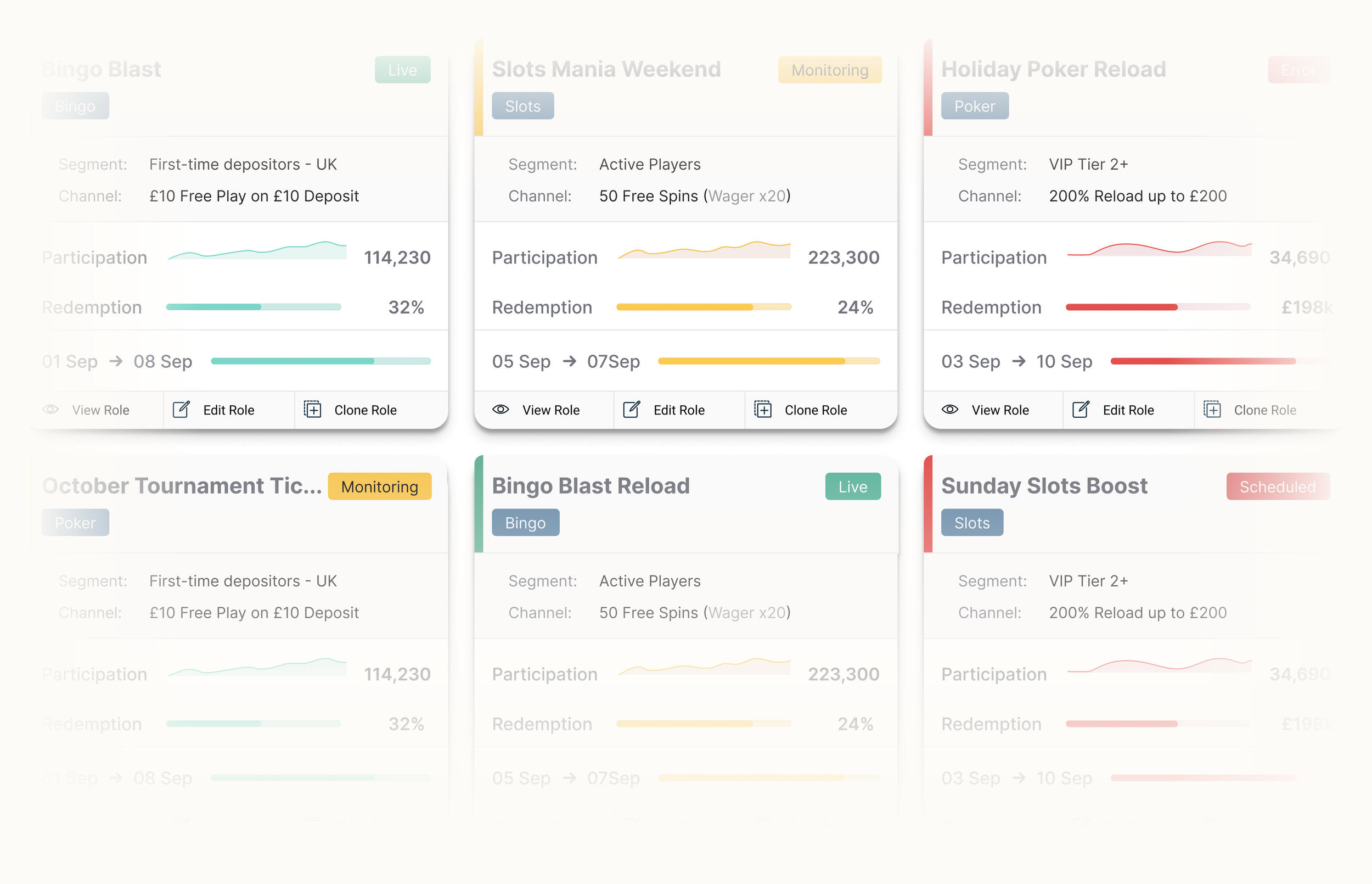
Promotional campaigns are a key driver of player acquisition and engagement.
These promotions were configured through an internal platform known as the bonus engine.


The platform allowed teams to configure multiple aspects of a promotion.
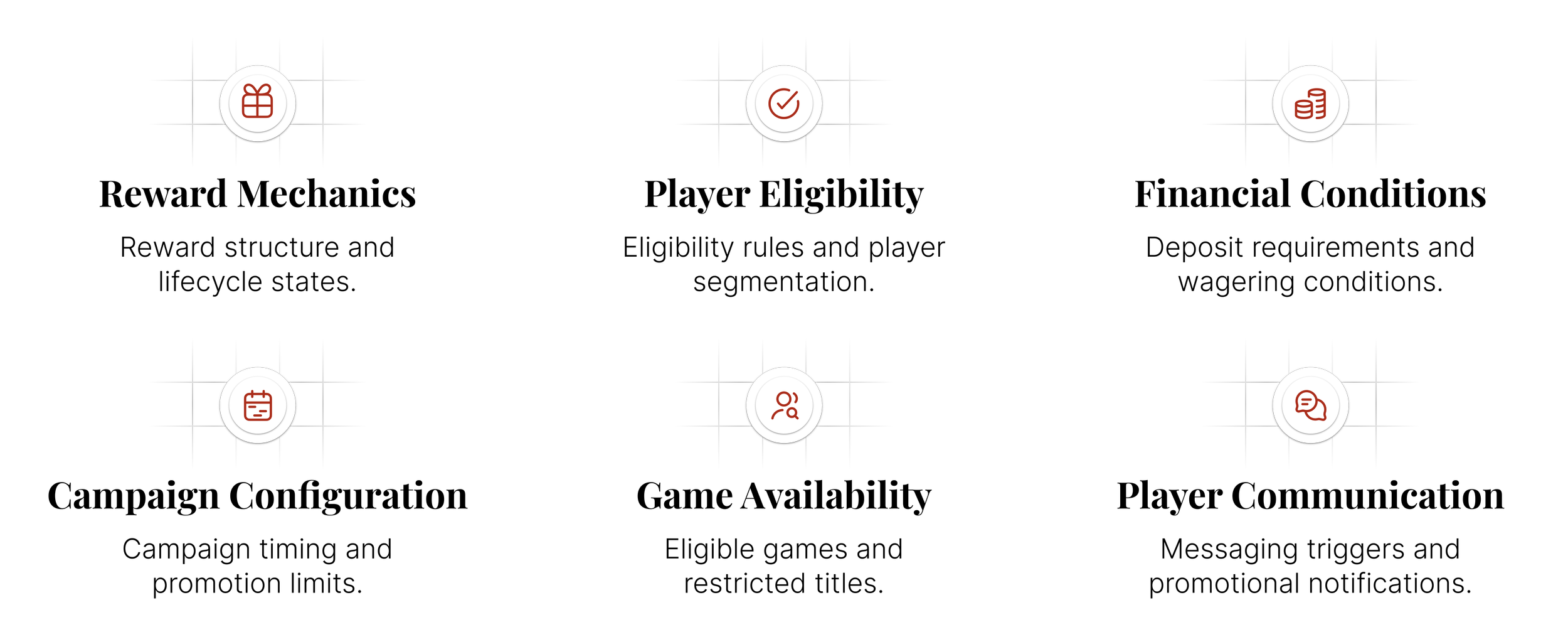
Because these configurations directly controlled how promotions behaved across the platform, mistakes could result in incorrect rewards, operational disruption, or compliance risk.
THE CHALLENGE
Over time the bonus engine had evolved into a complex configuration platform.
Creating or updating a promotion required navigating multiple rule types, reward states, eligibility conditions, and campaign parameters.
As the system grew, teams began to experience several operational challenges:




These issues slowed campaign launches and reduced confidence in the system.
More importantly, they created a gap between how the system behaved and how internal teams expected promotions to work.
USERS & RESEARCH
The Bonus Engine was used by multiple internal teams responsible for configuring and managing promotional campaigns across the digital platform.
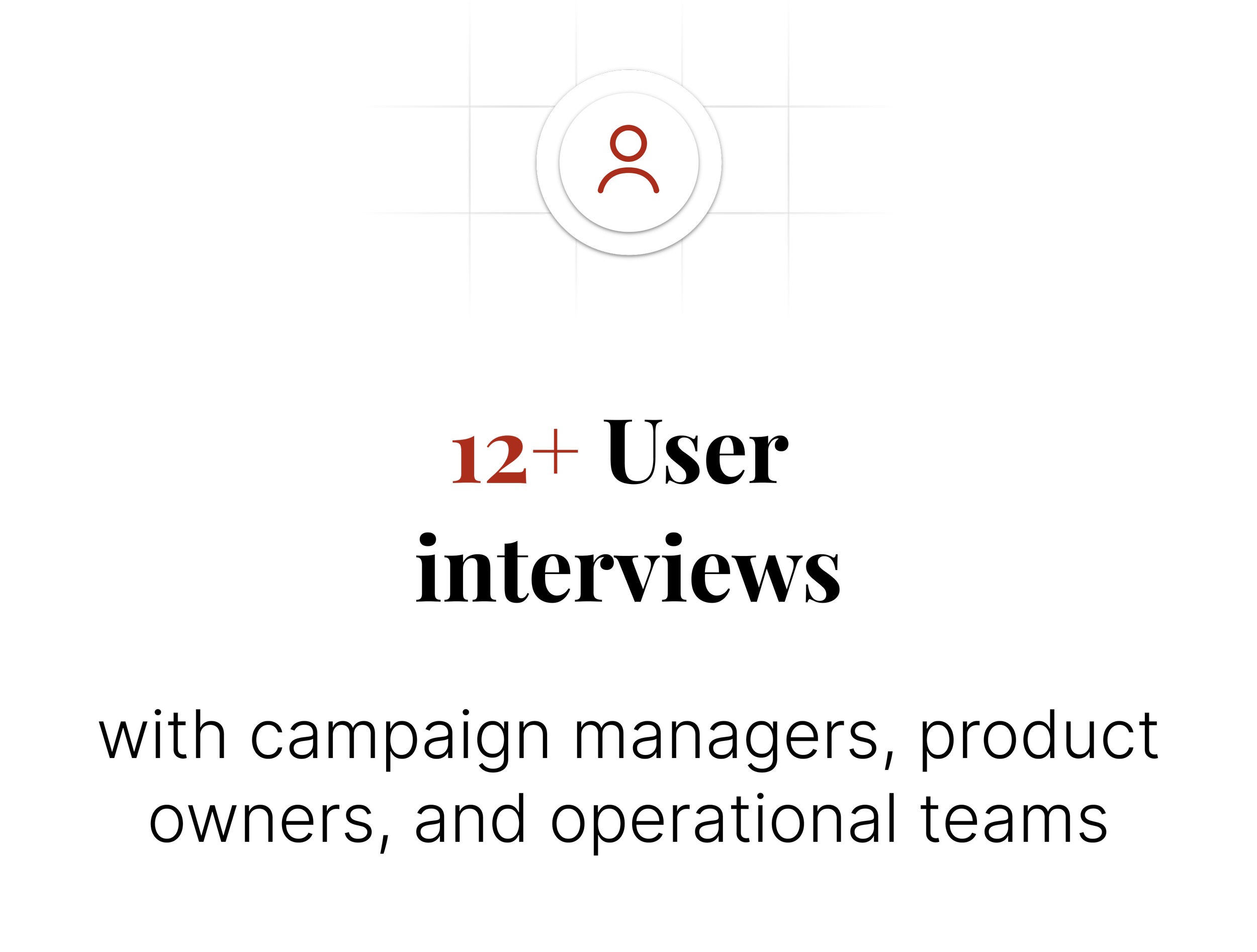
To fully understand the challenges, I led a structured discovery phase combining user interviews, workflow analysis, and cross-functional workshops with teams across London, Gibraltar, Mauritius, and Cape Town.
Participants included campaign managers, product managers, operations specialists, and compliance teams who interacted with the system at different stages of the promotion lifecycle.
This research uncovered usability challenges within the interface as well as deeper issues in how promotions were configured, validated, and managed across a globally distributed organisation.
Discovery activities.
The discovery phase focused on understanding both the configuration workflow and the underlying system logic behind promotion setup.
Activities included:
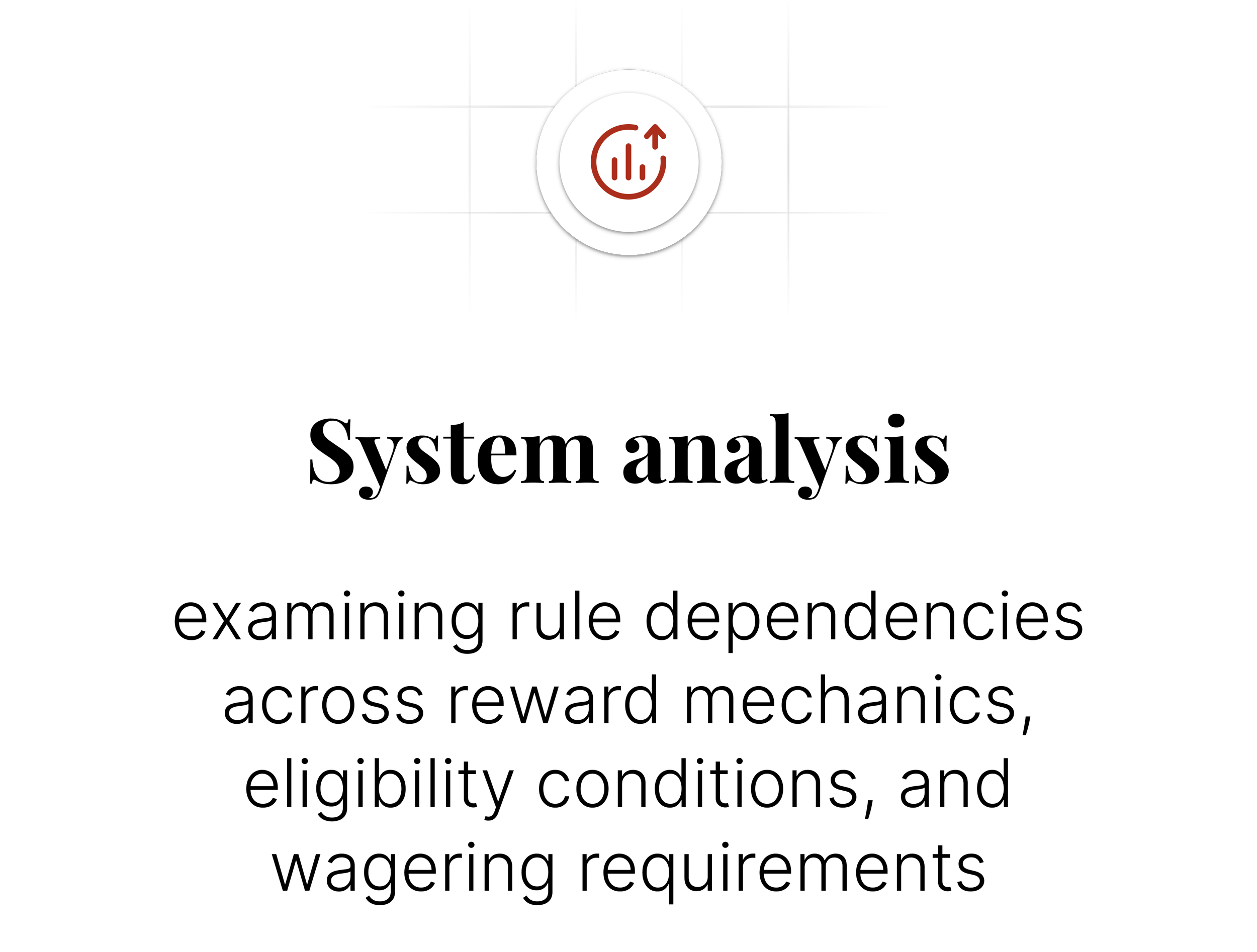
These activities helped uncover the gap between how teams configured promotions and how the system ultimately interpreted those rules.
OPERATIONAL SIGNALS
Operational feedback and internal metrics revealed recurring issues with promotion configuration and campaign management.
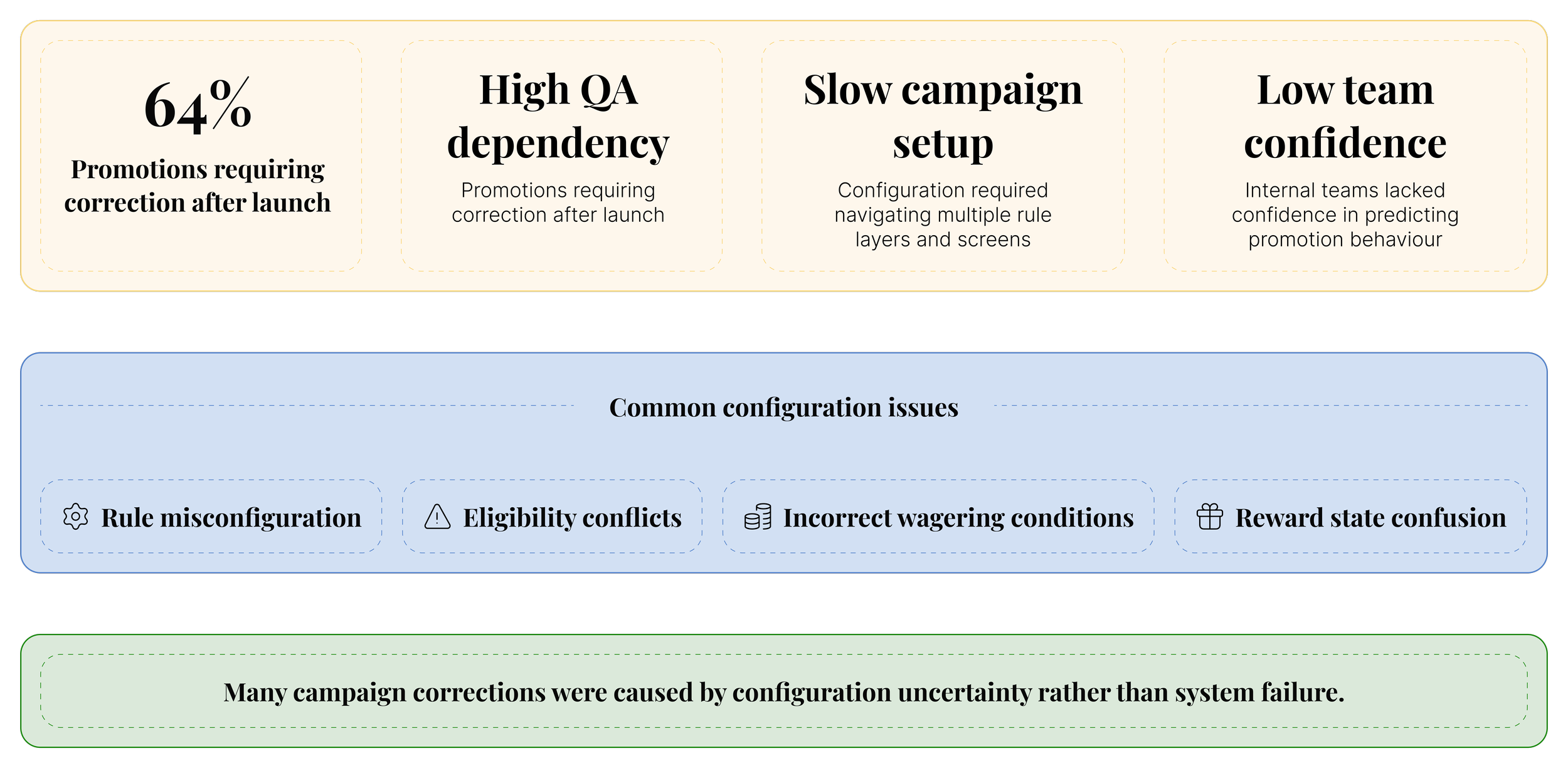
Campaigns frequently required corrections after launch, and teams relied heavily on QA validation to ensure rules behaved as expected.
Operational signals.
Creating a promotion required navigating multiple interconnected rule steps before launch.
Insight.
Configuration issues were rarely caused by system failures. Instead, teams lacked confidence that promotions had been configured correctly before launch.
DISCOVERY
To understand the root causes behind these signals, the system was analysed from three perspectives: ecosystem context, configuration architecture, and operational workflows.
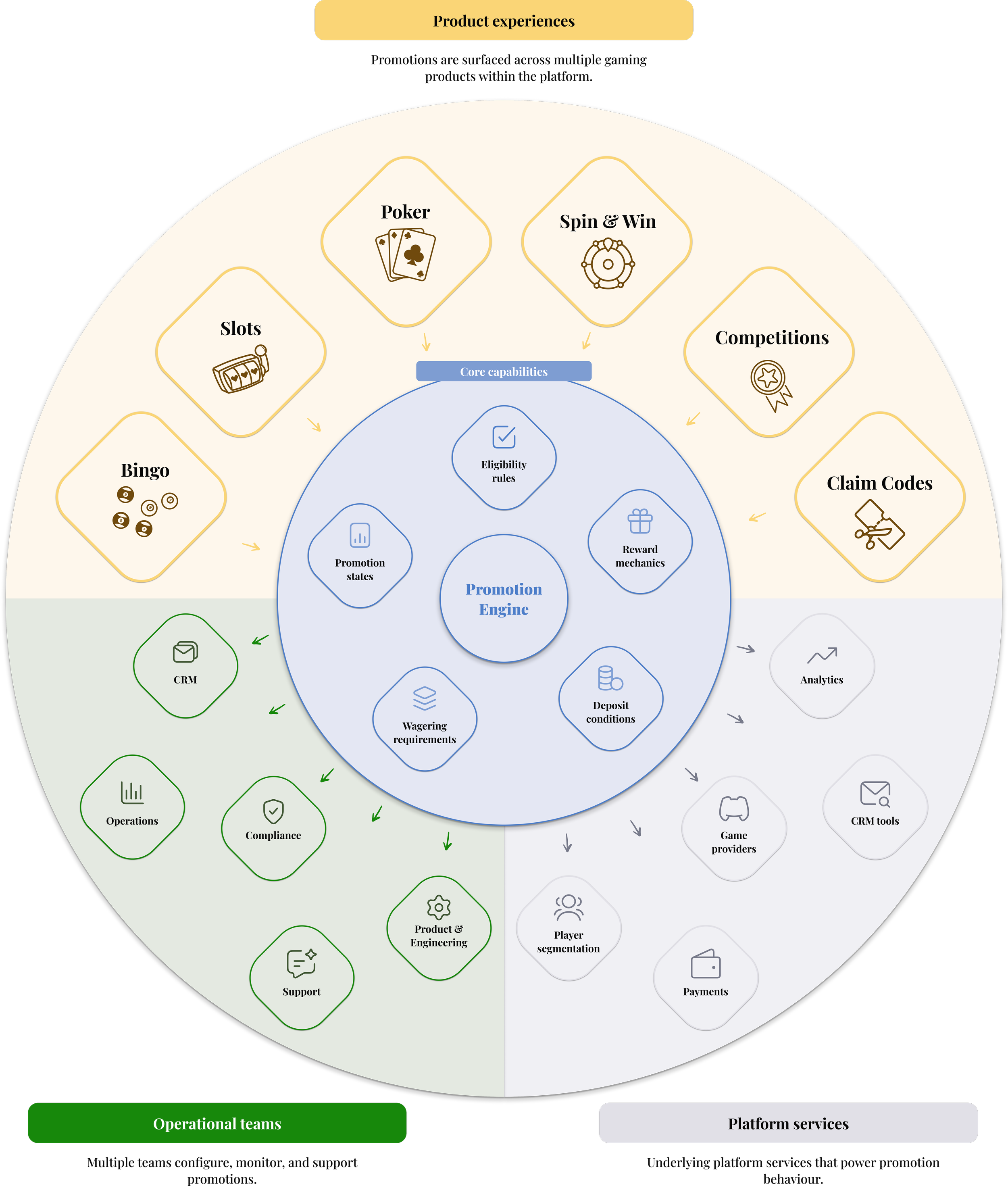
Understanding the incentive ecosystem.
Promotions were part of a broader ecosystem connecting multiple gaming products, operational teams, and platform services.
The Bonus Engine acted as the central orchestration layer coordinating incentives across the platform.
Incentive ecosystem
System insight.
The Bonus Engine sits at the centre of a complex ecosystem connecting multiple products, operational teams, and platform services.
Configuration decisions made within the engine directly influence player experiences, operational workflows, and compliance outcomes.
Deconstructing the configuration architecture.
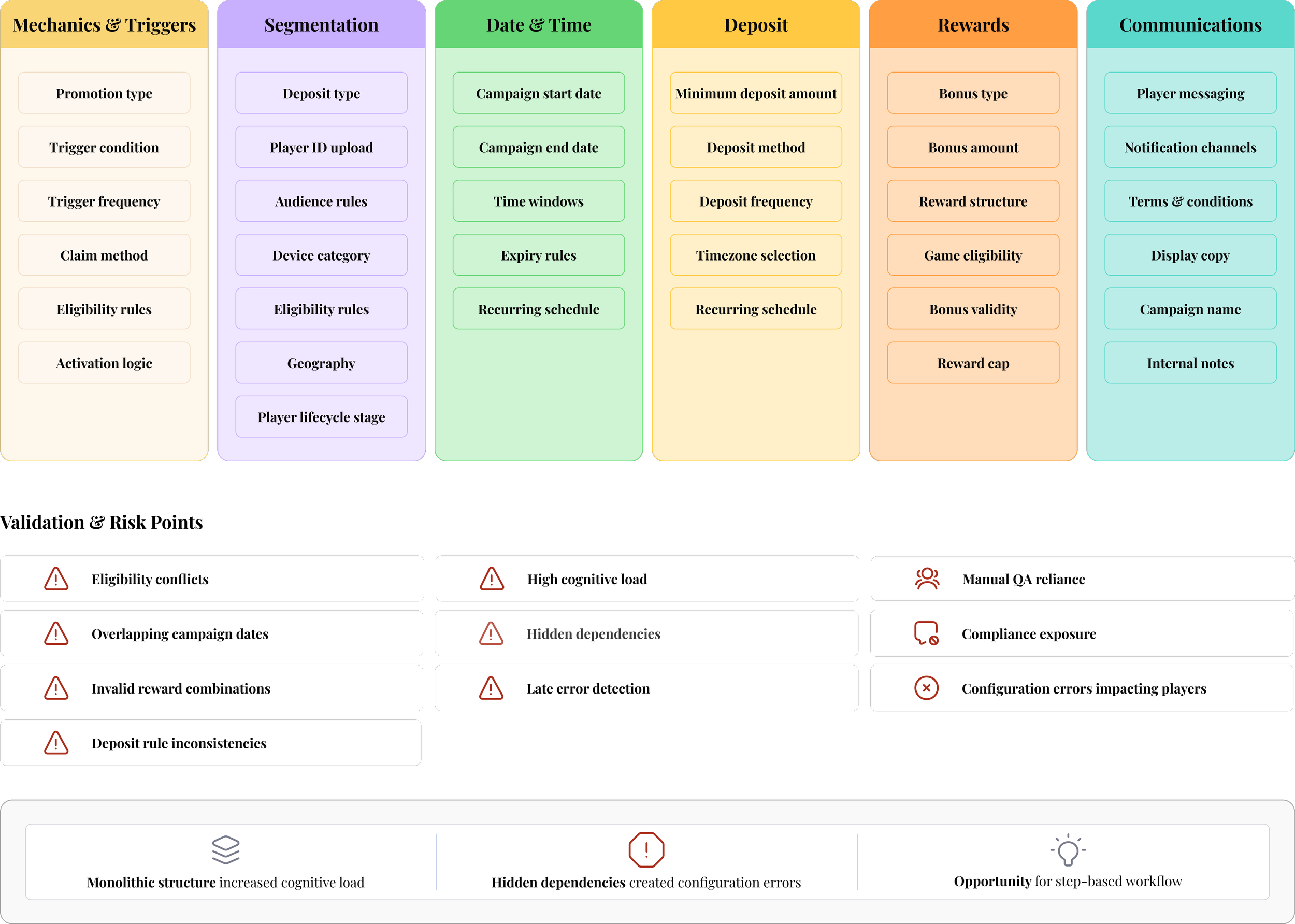
The promotion setup interface was deconstructed into its underlying rule architecture.
Promotions required defining multiple interdependent parameters including mechanics, segmentation rules, deposit conditions, reward structures, and campaign timing.
Form deconstruction & rules architecture
Insight.
Hidden rule dependencies increased cognitive load and led to configuration errors.
Understanding the operational lifecycle.
Promotions were not static configurations but part of an operational lifecycle involving campaign launch, monitoring, investigation, and support.
Operational journey & dashboard needs
Insight.
Limited visibility into promotion behaviour created operational friction and manual investigation.
SUCCESS METRICS
Following the discovery phase, we facilitated a cross-functional workshop with product, engineering, operations, and compliance teams to define what success would look like for the redesigned system.
Addressing these challenges required improving configuration clarity, introducing better validation mechanisms, and supporting the full operational lifecycle of promotions.
Three outcome areas were identified.

DESIGN STRATEGY.
Discovery revealed that the challenge was not simply the complexity of promotion rules, but how that complexity was presented to the teams configuring them.
While the system itself behaved deterministically, the configuration interface made it difficult for teams to understand how rules interacted, predict outcomes, or validate behaviour before launch.
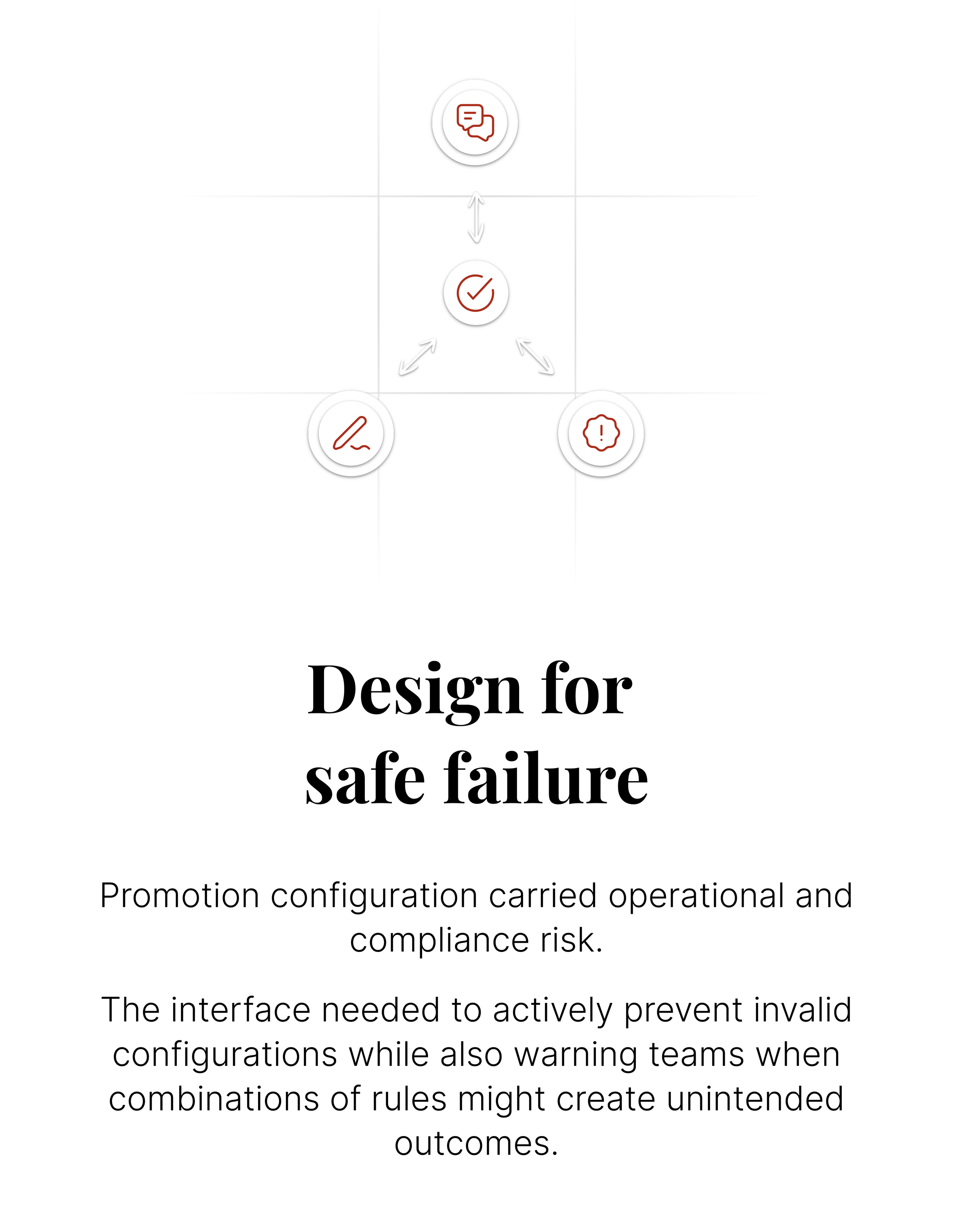
Strategic direction.
The solution focused on three core improvements to the promotion configuration experience: introducing a structured configuration flow, surfacing rule dependencies and system logic, and enabling teams to confidently validate promotions before launch.
Together, these changes aimed to reduce configuration errors, improve operational visibility, and increase confidence for the teams responsible for managing promotions.
SOLUTION
Discovery showed that promotion configuration was difficult to understand because rule dependencies were hidden, configuration decisions were scattered across a large form, and validation relied heavily on manual QA.
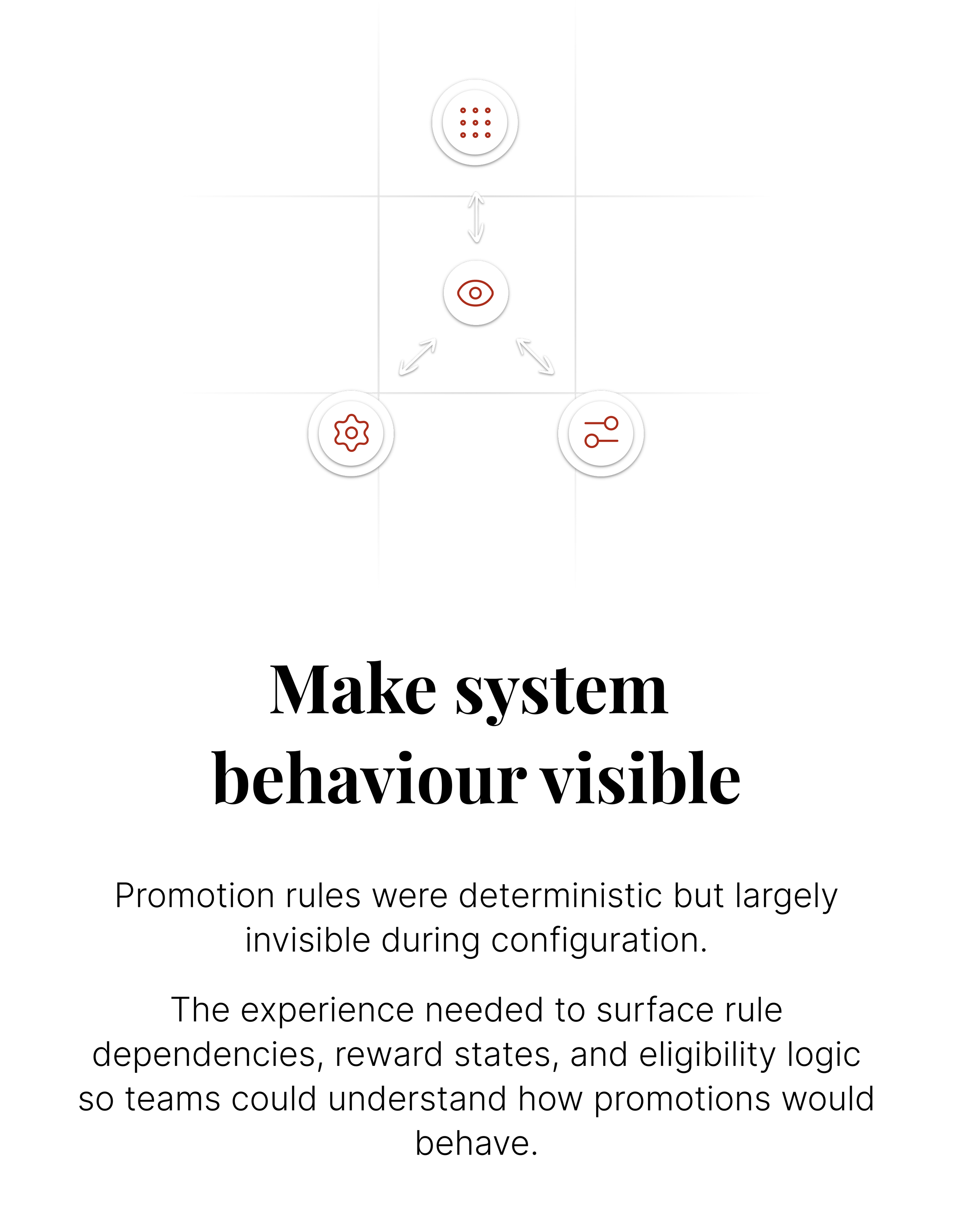
The redesign focused on making system behaviour visible while guiding teams through a structured configuration workflow.
Solution flow

This flow was designed to make the rules engine transparent and guide users through safe and effective promotion setup.
Campaign overview.
Promotion management begins in the Operational dashboard, where teams can view active and scheduled campaigns.
A card-based layout surfaces key campaign details such as reward type, status, and activation windows, making promotions easier to scan.
Campaign cards dashboard
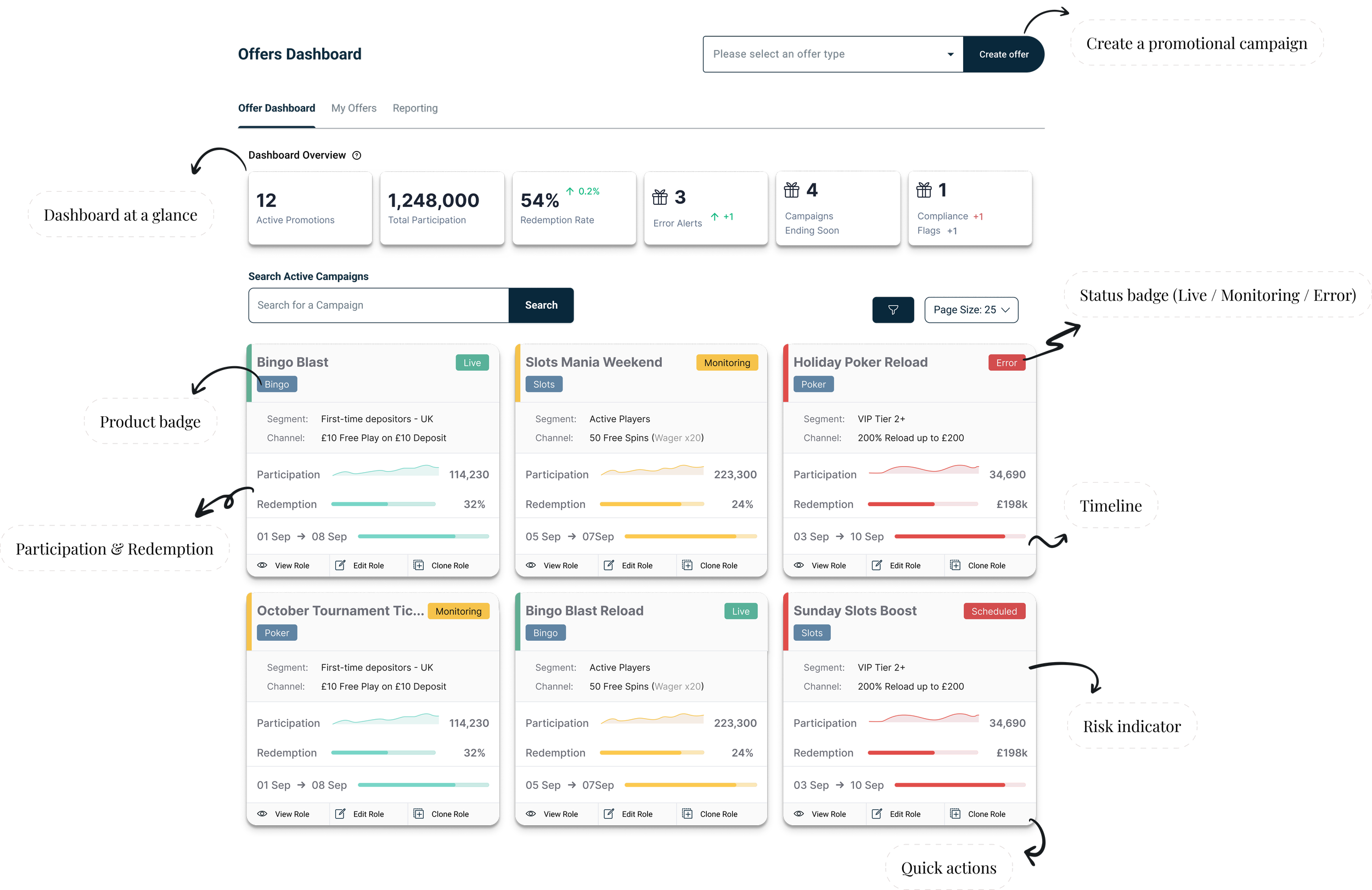
The interface was designed to support rapid scanning rather than deep data inspection.
Dashboard layout direction.
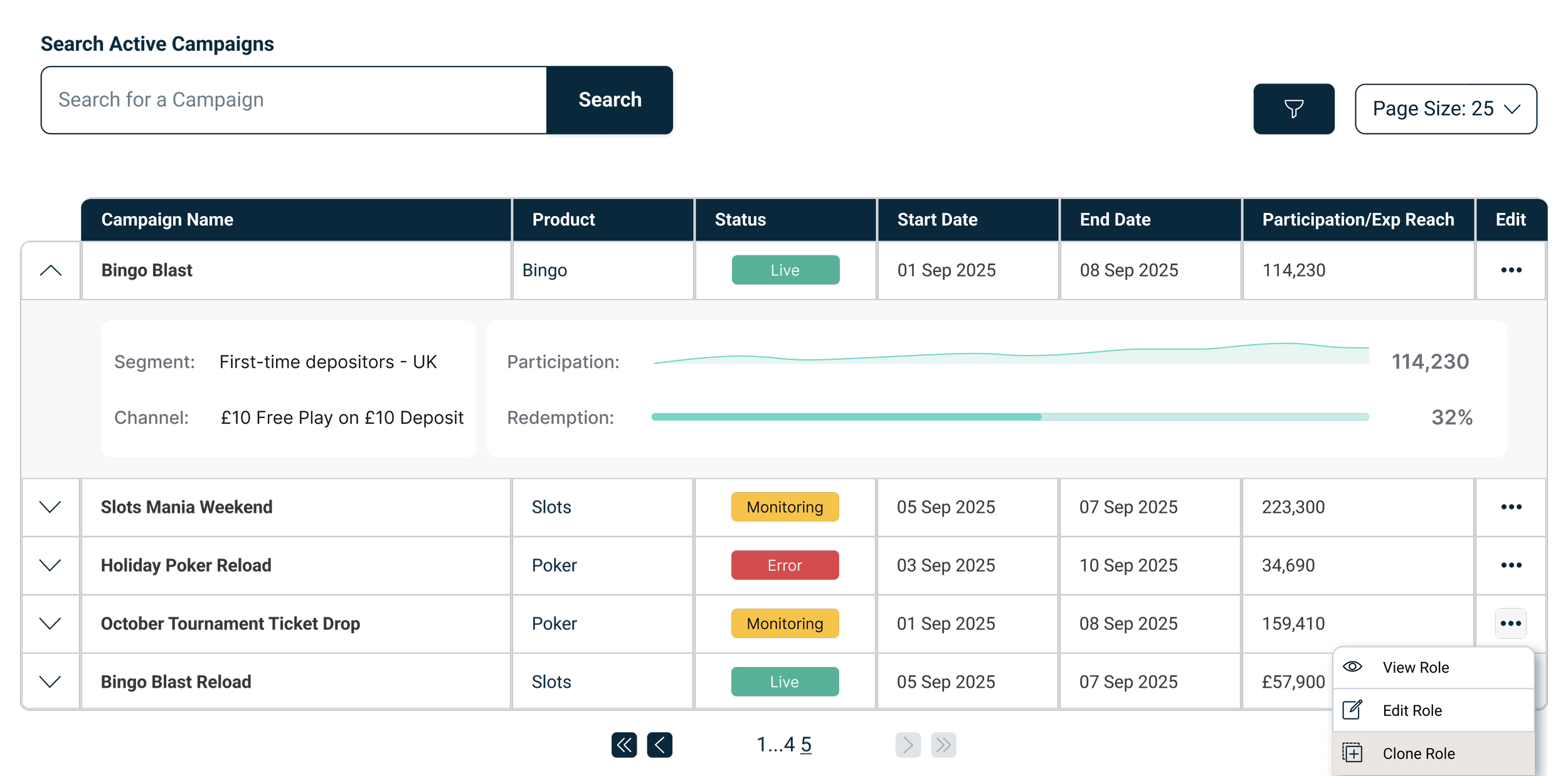
During exploration, both card and list layouts were considered. Cards provided clearer visual hierarchy, while a list view offered a more compact table format for managing large numbers of campaigns.
The card layout became the primary experience, with a list view toggle planned for future iterations.
Card layout direction + list view
Explicit rules & dependencies.
Discovery revealed that many dependencies between configuration fields were hidden, making promotion behaviour difficult to predict.
To address this, validation behaviour was mapped using a validation logic matrix, defining how the system should respond to rule conflicts, missing dependencies, and risky configurations.
Validation logic matrix
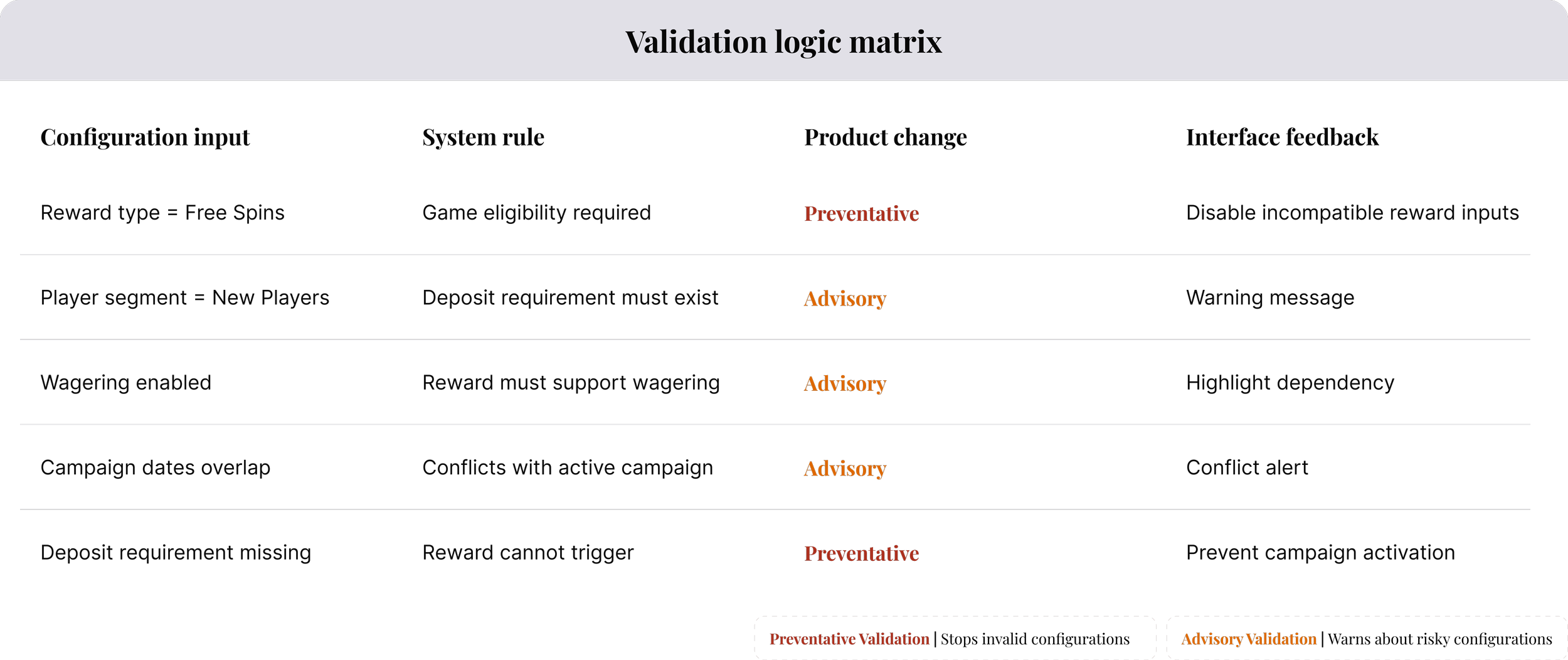
This framework allowed the interface to provide inline system feedback, guiding teams during promotion setup.
Configuring promotion rules.
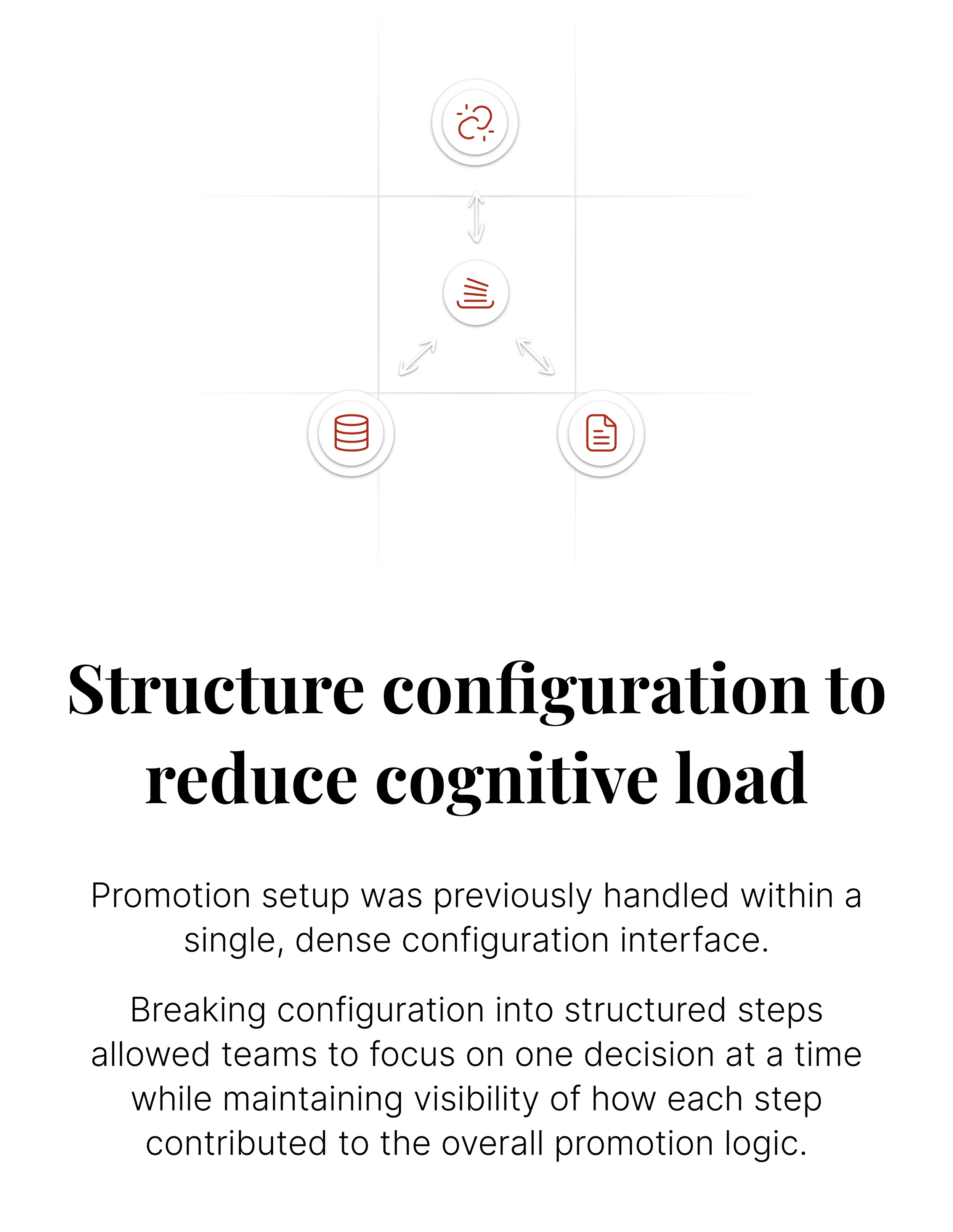
Promotion setup was redesigned as a structured configuration flow.
Instead of a single dense form, the new experience guides teams through the key stages of promotion setup such as eligibility conditions, deposit requirements, reward configuration, and wagering rules.
Configuration stepper
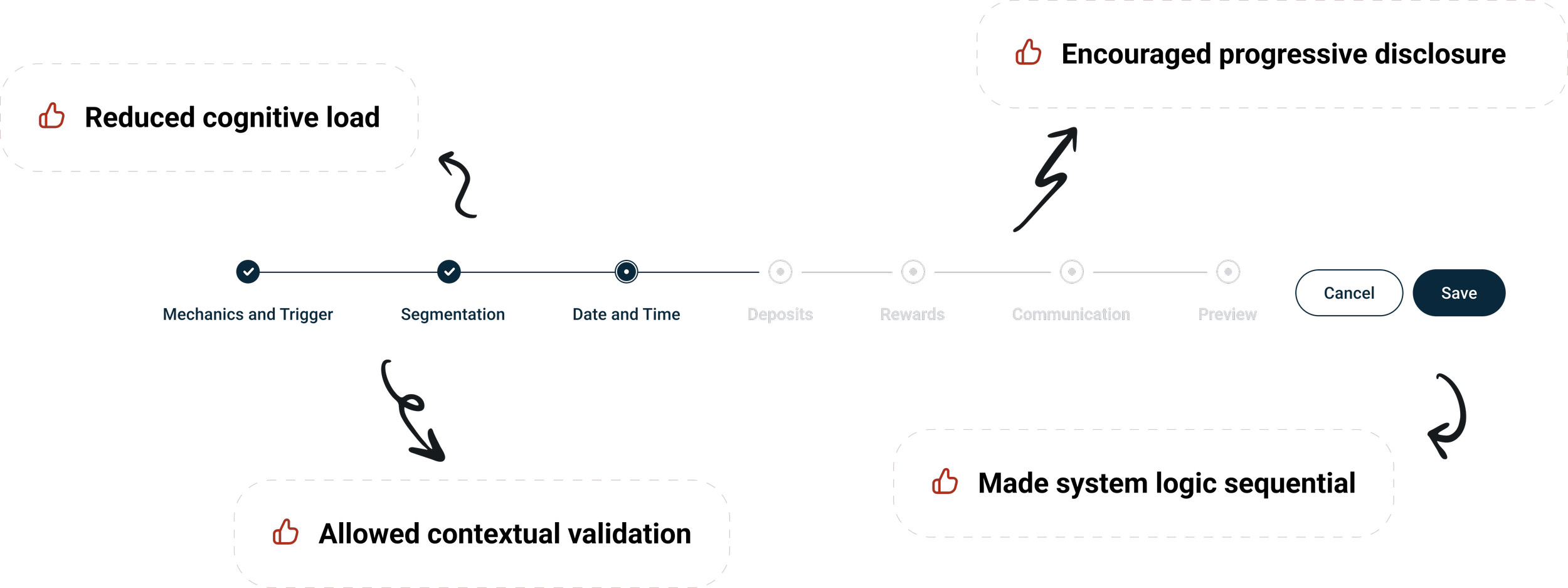
This structure reduces cognitive load by allowing teams to focus on one decision at a time.
Dynamic reward configuration.
The rewards section adapts dynamically based on inputs defined earlier in the configuration process.
Selections such as reward type, eligibility rules, and deposit conditions automatically adjust the available reward parameters.
Dynamic reward configuration
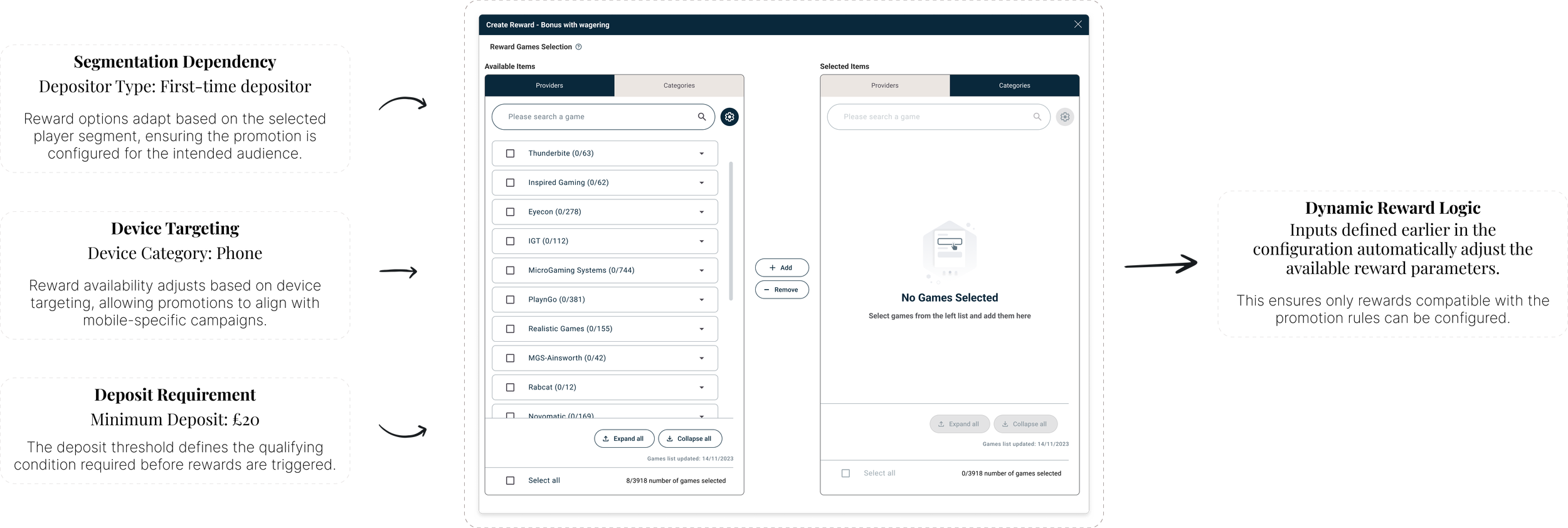
Inline rule logic
Earlier configuration decisions automatically shape the reward setup, reducing invalid configurations and making rule dependencies visible.
Preventative safeguards.
To prevent configuration errors.
The interface disables incompatible options and hides fields that are not relevant to the selected promotion type.
Disabled inputs / hidden fields
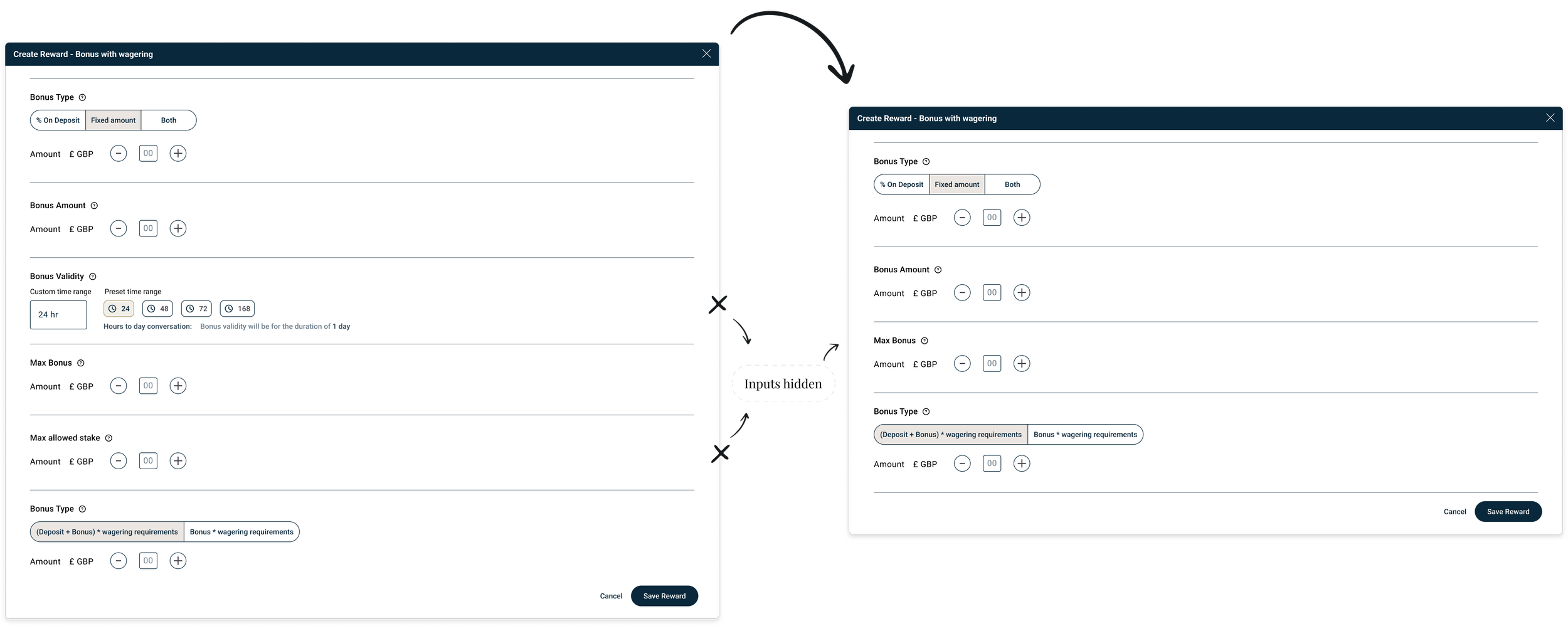
This prevents rule conflicts before they occur.
Advisory feedback.
Where configurations may introduce risk.
The system provides warning messages highlighting potential issues without blocking progress.
Warning examples
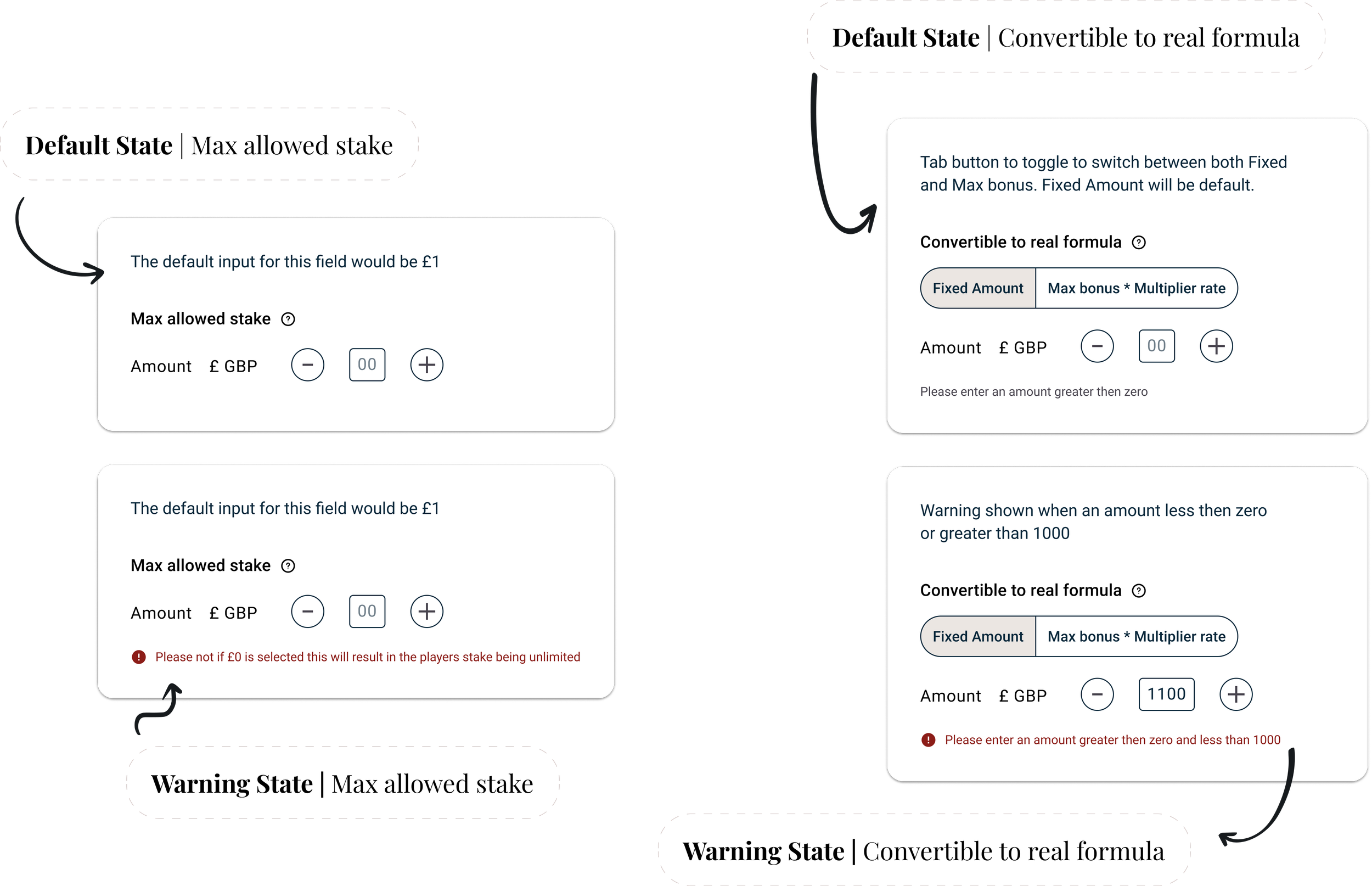
This allows teams to understand rule conflicts while maintaining flexibility.
Confident validation.
Before activating a campaign.
Teams review the full promotion configuration in a structured confirmation layer.
Review screen
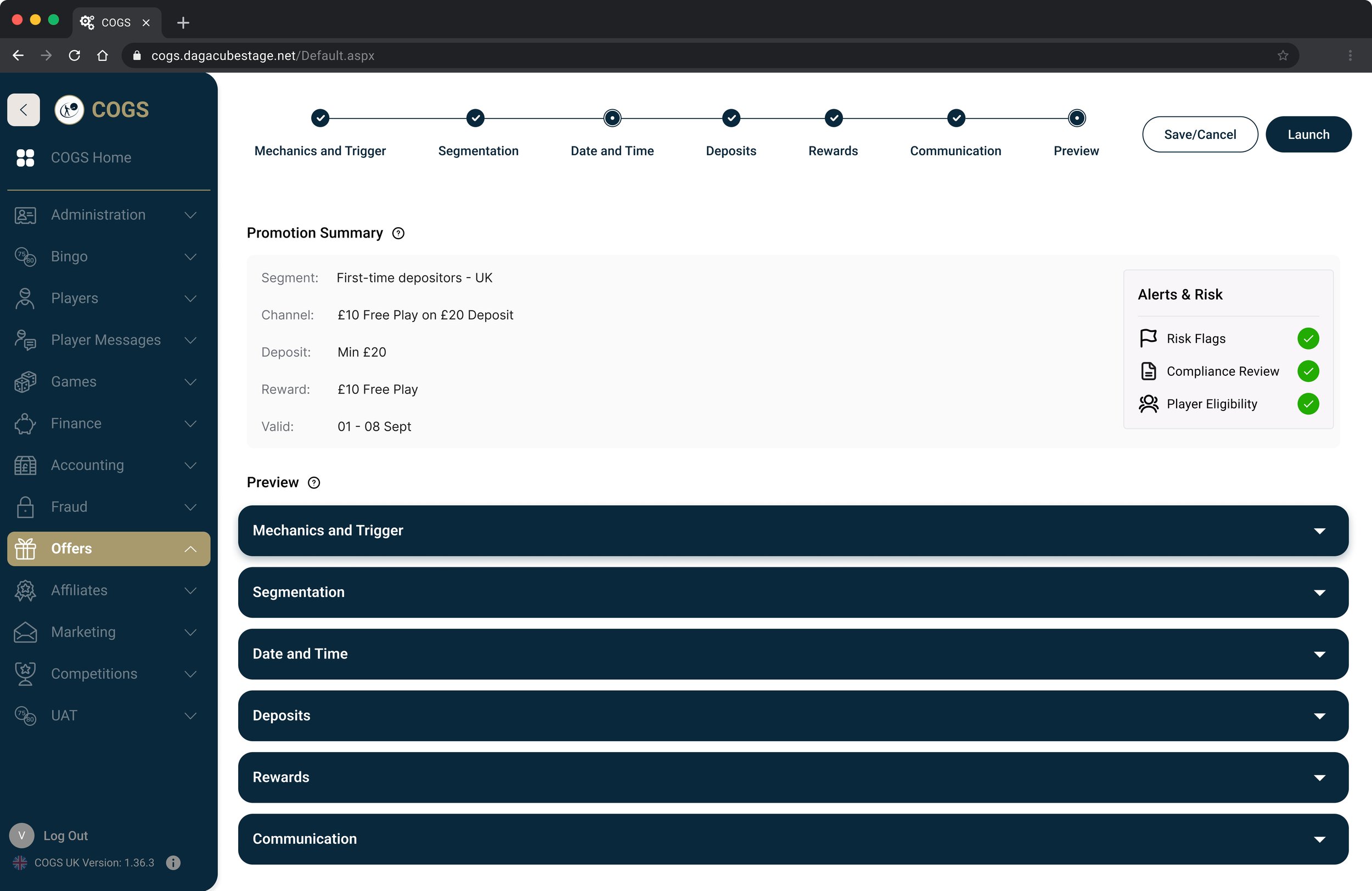
The validation screen displays key promotion details including eligibility rules, reward structure, deposit conditions, wagering requirements, and campaign timing.
This final step allows teams to verify that the promotion behaves as expected before launch.
Design strategy in action
The redesign introduced several structural changes to how promotions were configured and validated. Each design decision directly addressed issues uncovered during discovery.
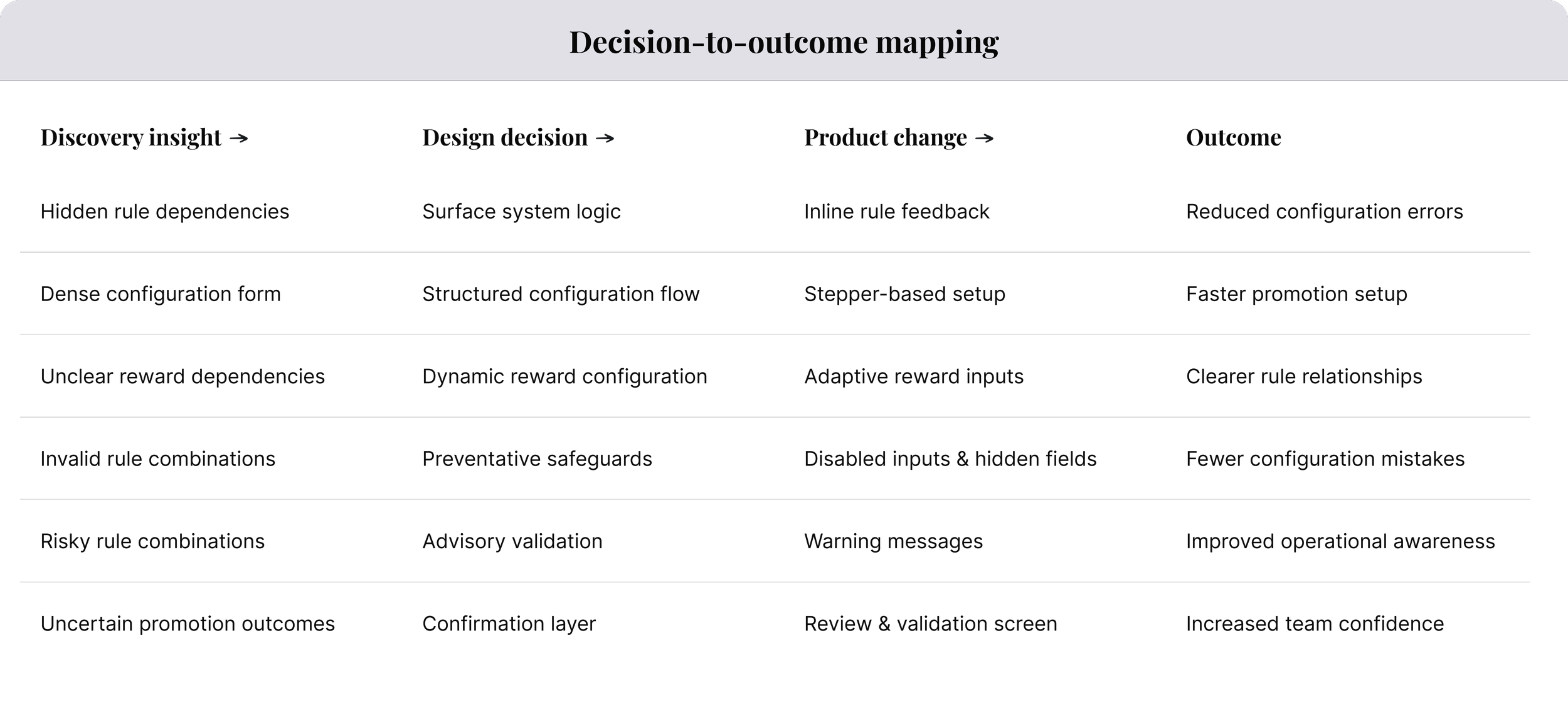
Mapping key discovery insights to design decisions and measurable improvements in promotion configuration.
The redesigned configuration experience improved both usability and operational efficiency across the teams responsible for managing promotions.
Impact
The redesigned configuration experience improved both usability and operational efficiency across the teams responsible for managing promotions.
Improvements were measured against the success metrics defined during the discovery workshop.
Usability.
Improving clarity and reducing cognitive load during promotion setup was a key objective of the redesign.
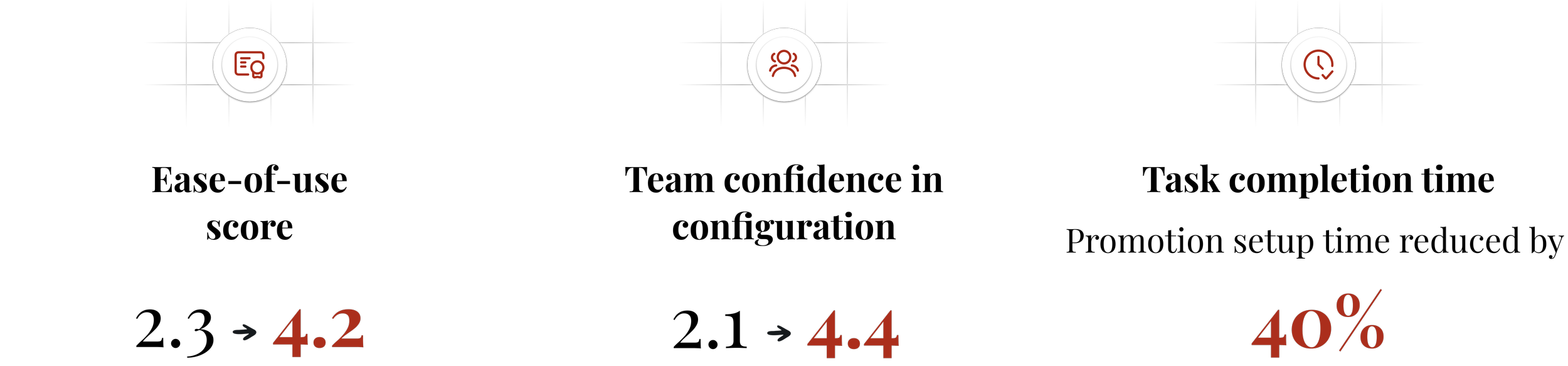
These improvements reflected the impact of the structured configuration flow, clearer rule dependencies, and dynamic configuration behaviour.
Operational efficiency.
The redesign also reduced the operational overhead required to create and manage promotions.
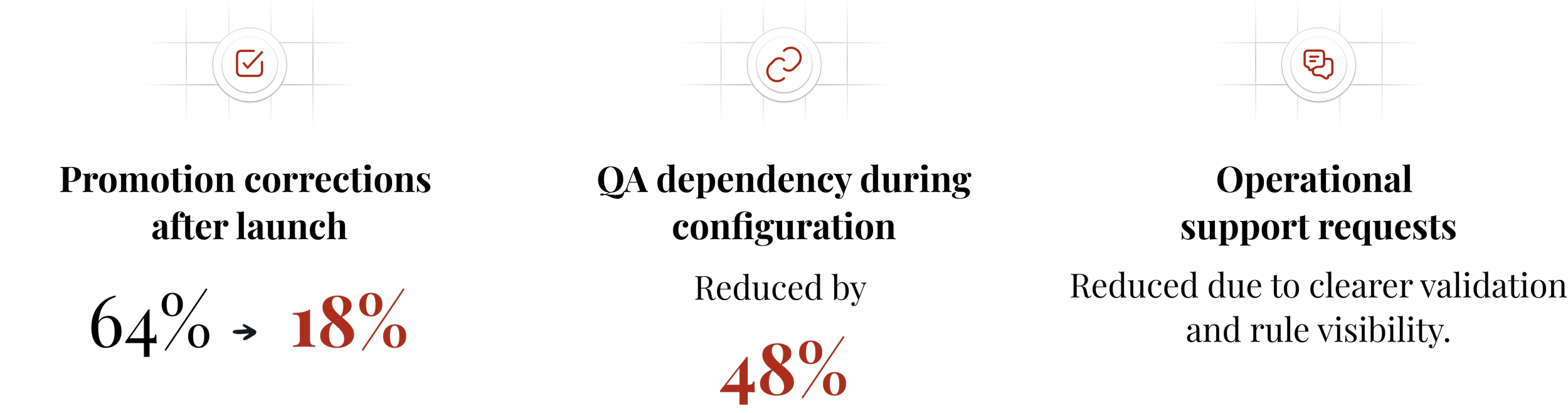
By preventing configuration errors earlier in the workflow, teams were able to launch campaigns with greater confidence and fewer manual interventions.
Governance & risk.
Because promotions control financial incentives, improving governance and reducing configuration risk was critical.

The introduction of validation logic and confirmation layers helped ensure that promotions were configured correctly before going live.
Key outcome.
By making promotion logic visible and guiding teams through a structured configuration workflow, the redesign transformed promotion setup from a complex, error-prone process into a predictable system teams could confidently operate.
Redesigning the first deposit experience to increase confidence and conversion
Improving clarity at the moment of commitment led to measurable gains in completion, reduced confusion, and lower support demand across the journey.
Player Management System
Reducing friction and decision fatigue in high-frequency player management tasks